Showing posts with label looted antiquities. Show all posts

Cracking Down on Antiquities Trafficking by Changing Homeland Security's "Seize and Send" Policy


Cracking down on the illegal antiquities trade by regularly prosecuting criminal offenders and dismantling their infrastructure must be a leadership priority for U.S. Immigration and Customs Enforcement's (ICE).  The Homeland Security Investigations (HSI) directorate of ICE currently pursues a "seize and send" policy focused on recovering and repatriating antiquities rather than investigating and indicting criminals.  That policy must change in order to effectively combat a crime that permanently destroys the archaeological record and injures both history and culture. 
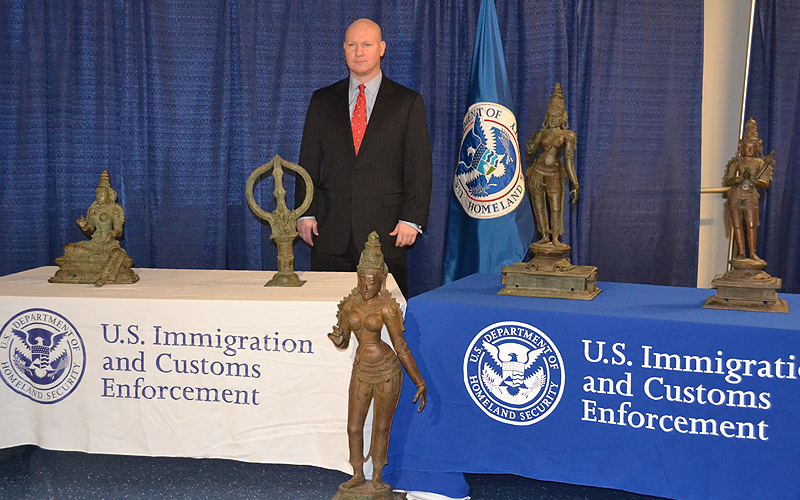
HSI Special Agent-in-Charge James Hayes with Indian idols seized last week.
ICE's seize and send policy is illustrated by many of the agency's press releases.  It was restated last week during a Chasing Aphrodite interviewwith James T. Hayes, Jr., Special Agent-in-Charge of HSI New York.  Hayes defended the seize and send policy: "'The focus is always to return stolen property to its rightful owners,' Hayes acknowledged, saying making criminal cases was desirable, but challenging. 'You have to have a legal basis to prove those items, and you have to prove certain things and that proves very difficult.  We’re dealing with laws around the world, in foreign courts and different jurisdictions.'"  HSI's chief added, "At the end of the day, our primary responsibility is to get stolen property back to its rightful owners."

Returning stolen property to owners is a regular goal of many law enforcement agencies.  But there is little indication that simply recovering and repatriating cultural property puts smuggling networks out of business.  Criminals engaged in the illegal antiquities trade surely realize that they face little or no risk of legal accountability for their actions. They must also be aware that the occasional confiscations by police of portions of their inventories do not actually take down their supply, transportation, conservation, distribution, marketing, and sales infrastructures.  That is why prosecutions, coupled with forfeitures of infrastructure assets (instrumentalities forfeitures), should be made part of law enforcement's response.

The decision not to pursue prosecutions and instrumentalities forfeitures on a regular basis produces several negative outcomes:

First, because antiquities traffickers go unindicted, the risk of offenders facing the consequences of prosecution--jail, fines, probation, and/or a criminal record--is eliminated.  Naturally, there is neither general nor specific deterrence against the commission of antiquities trafficking when there is no fear of getting caught.

Second, court sentences will continue to be light in those rare circumstances when antiquities smuggling prosecutions are actually brought forward.  That is because the judiciary, not seeing many cases on their dockets, will believe that this criminal activity is insignificant in scope or impact.

Third, the infrastructures used to facilitate antiquities trafficking will remain intact.  Seizures of ancient pots or Egyptian sarcophagi may remove the fruits of an antiquities trafficker's crime, but their confiscation by authorities likely represents a only portion of the trafficker's illegal inventory at any given moment.  Such limited seizures cannot be expected to shut down expansive global networks operating continuously.  Seizures of the instrumentalities used to commit antiquities trafficking, by contrast, could help dismantle large swaths of trafficking infrastructures.  Just as asset forfeitures in drug cases confiscate the automobiles, boats, planes, homes, etc. used in unlawful narcotics manufacturing and distribution networks, seizures of the instrumentalities used to traffic illegal antiquities could disrupt or shut down antiquities trafficking chains.

Finally, prosecutors and police will continue to confront both a learning curve and inefficiency so long as there iis no change in enforcement policy.  Routine antiquities trafficking prosecutions and enforcement, by contrast, would prompt prosecuting attorneys and detectives to meticulously learn how the crime operates, what evidence is commonly found in such cases, and what legal defenses typically arise.  The experiences gained would foster more efficient criminal investigations in the field and more effective legal cases in the courtroom.

HSI's chief is correct to observe that antiquities trafficking cases can be complex.  But law enforcement authorities over the decades have discovered ways to unravel complex transnational transactions.  If complicated international money laundering, commodities smuggling, and drug trafficking cases can be solved and prosecuted, so too can antiquities trafficking cases.  Indeed, criminal organizations would have little incentive to cease trafficking operations if law enforcement conceded that their activities were too hard to prosecute.

When criminal investigations become too complex to warrant effective action under one set of laws, one enforcement tactic is to separate the overall crime into component parts, examining the parts under different statutes.  So instead of building an antiquities trafficking case broadly around the National Stolen Property Act, for example--which relies on an review of foreign ownership laws to determine if a trafficking suspect has knowingly received stolen antiquities in violation of the statute--authorities might shift their focus to build a case on the basis of false statements.  Put another way, one method of not "dealing with laws around the world, in foreign courts and different jurisdictions" is to focus on the cover-up rather than the crime.

It is widely known that criminals rarely act in the open, committing fraud and deceit to conceal their activities.  That is why criminal cultural property importers oftentimes falsify customs paperwork, classifying looted antiquities as something else on import forms.  Making a false statement on an official customs form is a crimeunder 18 U.S.C. 542, and prosecutions under this statute do not require reliance on anything except evidence of criminal falsification.  Juries simply need to be shown that an ancient antiquity found in a cargo crate is not a "garden table set" or some other false description written down on a customs form. Criminal knowledge of the false statement, meanwhile, can be demonstrated by additional positive evidence and/or by circumstantial evidence--which counts in a criminal case--showing that the criminal defendant was “without reasonable cause to believe the truth of such statement.”  This example demonstrates that there may be other, potentially simpler, legal and investigative options available to authorities.

Cicero said, "What one has, one ought to use: and whatever he does he should do with all his might."  HSI agents are seasoned investigators who should be given the green light to use their skills with all their might in an effort to expose the illegal antiquities trade and take down its networks.  Partnering with prosecutors, HSI should systematically apply the National Stolen Property Act, the false statements law, and many other federal laws to successfully combat antiquities trafficking.  Referring cases for state prosecution should also be a routine consideration rather than an occasional one.  Coupled with the seizure of assets used to facilitate antiquities trafficking, regular prosecutions in the courts would dismantle or disrupt these criminal networks more effectively than the current seize and send policy.


This post is researched, written, and published on the blog Cultural Heritage Lawyer Rick St. Hilaire at culturalheritagelawyer.blogspot.com. Text copyrighted 2012 by Ricardo A. St. Hilaire, Attorney & Counselor at Law, PLLC. Any unauthorized reproduction or retransmission of this post is prohibited. CONTACT: www.culturalheritagelawyer.com

Documentary - "Fighting Illicit Traffic of Cultural Heritage in South Eastern Europe"

UNESCO has produced the short documentary below titled "Fighting Illicit Traffic of Cultural Heritage in South Eastern Europe."  The report is especially relevant as the Cultural Property Advisory Committee (CPAC) this month considers requests by Bulgaria and Cyprus for cultural property protections under the Cultural Property Implementation Act (CPIA).


CONTACT: www.culturalheritagelawyer.com

Status Conference Held in Case of US v. Khouli, Alshdaifat, Lewis

Egyptian coffin seized by ICE
in the case of US v. Khouli et al.
Photo: ICE
The US District Court for the Eastern District of New York held a status conference in the criminal matter of United States v. Khouli et al. on November 17, 2011.  The court waived all three of the defendants’ presence at the hearing.  The defendants include Mousa “Morris” Khouli, Salem Alshdaifat, and Joseph A. Lewis II.  Ayman Ramadan remains a fugitive.

By way of letter dated November 4, 2011 and written by his attorney, Khouli sought leave to attend a coin show in Baltimore, Maryland, reportedly scheduled for November 16 and 20.  The short letter explained: “As an antiquities dealer, Mr. Khouli’s livelihood depends on his ability to attend coin shows and other similar events.”  The court granted Khouli’s request and extended the ruling, waiving the appearance of the other co-defendants.

Internet records reveal that the Whitman Coin & Collectibles Baltimore Expo was held during this time.  Palmyra Heritage, the name of the business owned and operated by Khouli, was listed as occupying booth #1107 while Holyland Numismatics, the name of the business owned and operated by Alshdaifat, was listed as occupying booth #1154 at the event that took place at the Baltimore Convention Center.

Salem Alshdaifat’s attorney filed documents soon after the November 17 status hearing requesting a change of venue in an effort to curtail any hardship to Alshdaifat, who lives in Michigan.  Submitted on November 21, the pleadings reveal more information about Alshdaifat’s background and his association with co-defendant Ayman Ramadan.  The pleadings also supply a preview of Alshdaifat’s possible legal defenses.  These topics are discussed here.

The next court status conference is scheduled for January 27, 2012.

Recovery of Looted Egyptian Tomb Reliefs Leaves Unanswered Questions

The ancient Egyptian tomb of Hetepka featured prominently in the widely publicized court cases against Frederick Schultz in the United States and Jonathan Toleley-Parry in Britain as well as in a related criminal case in Egypt. Schultz, Tokeley-Parry, Ali Farag, Toutori Farag, Andrew May, and Mark Parry were all convicted during the late 1990's and early 2000's for their roles in an international antiquities trafficking scheme. That is why Ahram Online’s October 15, 2011 report that two looted limestone reliefs from Hetepka's tomb were “newly recovered” by the Egyptian Tourism and Antiquities Police is noteworthy.

Hetepka served as a royal hairdresser during the pyramid age, and modern-day looters dismembered and destroyed his tomb located at Saqqara. Police eventually found some of the tomb artifacts in Tokeley-Perry’s possession in England, but did not recover all the items that were looted. Ahram Online’s report suggests that the newly recovered reliefs are part of the original cultural objects that went missing from the tomb.

News of the recovery raises many questions:

• On what date and under what circumstances were the reliefs found?

• What information, and from what source(s), led the Egyptian Tourism and Antiquities Police to the reliefs?

• Where exactly were the reliefs found and under what circumstances?

• Whose possession were they in?

• What other items, if any, were also found?

• How are these reliefs related to items that may have been stolen from the tomb recently. Recall that former point-man for Egyptian antiquities, Dr. Zahi Hawass, referenced the Hetepka tomb when discussing his resignation on his blog at http://www.drhawass.com/blog/why-dr-hawass-resigned, saying: “The group now in charge of the protection of these sites is the Tourist Police, but there are no Tourist Police to do this either. Therefore, what happens? Egyptian criminals, thieves (you know, in every revolution bad people always appear…), have begun to destroy tombs. They damaged the tomb of Hetep-ka at Saqqara . . . . They attacked a storage magazine at Saqqara and we do not yet know how many artifacts are missing . . . . People have begun to build houses and to excavate at night, everywhere, putting heritage sites all over the country at risk.”

• Ahram Online reports that the recovered Hetepka reliefs were stolen in 1986. How is this known by the news outlet, especially since prior investigative information revealed that Hetepka’s tomb had been plundered in 1991?

Ahram Online’s report is conspicuously vague. You can read the article at http://english.ahram.org.eg/~/NewsContent/9/40/24162/Heritage/Ancient-Egypt/Two-reliefs-stolen-from-Hetepka-tomb-found.aspx.


Contact information may be found at www.culturalheritagelawyer.com. DISCLAIMER: The information provided on this web site/email/blog/feed is general information only, not legal advice, and not guaranteed to be current, correct, or complete. No attorney-client relationship is formed, and no express or implied warranty is given. Links or references to outside sources are not endorsements. This site may be considered attorney advertising by some jurisdictions. The attorney is licensed in NH. The attorney is not certified by the TX Board of Legal Specialization, nor certified by NY regulators as a so-called "specialist" or "expert." Do not send confidential communications through this web site or email.

Ancient Egyptian Relief from Abusir Recovered

A February 1, 2011 post on this blog spoke about the conflicting reports out of Egypt regarding looting at Abusir. The government reported that the area was safe, while other information suggested otherwise. Now there is information from Ahram Online of the following:

"On Tuesday [October 11, 2011], the Egyptian Tourism and Antiquities Police succeeded in recovering an ancient Egyptian limestone relief which had been reported missing during the chaos that followed the January 25 Revolution.

The relief, which was discovered by the Czech archaeological mission in Abusir, was one metre tall and 60 centimetres wide. It depicted four walking geese with a hieroglyphic text.

Atef Abul Dahab, head of the ancient Egyptian department at the Supreme Council of Antiquities (SCA), told Ahram Online that the relief was one amongst those that were looted from the Abusir storage, following the lack of security after the events in January."


Contact information may be found at www.culturalheritagelawyer.com. DISCLAIMER: The information provided on this web site/email/blog/feed/podcast is general information only, not legal advice, and not guaranteed to be current, correct, or complete. No attorney-client relationship is formed, and no express or implied warranty is given. Links or references to outside sources are not endorsements. This site may be considered attorney advertising by some jurisdictions. The attorney is licensed in NH. The attorney is not certified by the TX Board of Legal Specialization, nor certified by NY regulators as a so-called "specialist" or "expert." Do not send confidential communications through this web site or email.

Conflicting Reports About Abusir: "Nothing Has Been Stolen" v. "Targeted By Thieves"

Starkly contrasting reports have been given about the condition of archaeological sites at Abusir. Abusir is home to a Fifth Dynasty royal necropolis containing over a dozen pyramids, including those of Sahure and Nefirirkare.

Zahi Hawass, newly appointed Minister for Archaeology, told Fox News today: “Everything is safe at the site of Abusir." “Nothing has been stolen from Abusir.”
(Source: www.foxnews.com/scitech/2011/01/31/egypts-treasures-saved-looters-vandals/#ixzz1CegBUuMY)

But Miroslav Barta, a leading archaeologist who conducted the first satellite mapping of the pyramid fields of Abusir, yesterday reported the following for Czech Position:
"Archeological objects in the pyramid field of Abusir uncovered by Czech expeditions over the last 50 years were also targeted by thieves. The extent of the damage caused will have to be examined later because organized gangs are operating in the desert both night and day. Although these gangs’ raids are haphazard, it’s almost certain that artifacts of immeasurable historical value have been destroyed or damaged." Professor Barta added that "[t]he information about the state of the monuments in the pyramid field came from Egyptian colleagues who had been shot at by gangs of raiders."
(Source: www.ceskapozice.cz/en/news/foreign-affairs/czech-egyptologist-ancient-egyptian-sites-damaged-during-unrest)

Meanwhile Nick Parker, Chief Foreign Correspondent at The Sun, today reported from Abusir that archaeology in the area had been hit by thieves.
(Source: www.thesun.co.uk/sol/homepage/news/3383389/SCHOLARS-fear-losing-Egypts-antiquities-as-museums-are-looted-in-revolt-against-tyrant.html)

The reports by Barta and Parker support information contained in an email posted earlier on this blog by Sarah H. Parcak, Assistant Professor at the Department of History and Anthropology at the University of Alabama at Birmingham. The email described archaeological damage at the Abusir site.

LCCHP and Other Organizations Warn of Cultural Heritage Emergency in Egypt

The Lawyer's Committee for Cultural Heritage Preservation, joined by other organizations, has issued on the situation involving cultural heritage in Egypt. That statement is below:

The undersigned cultural heritage and archaeological organizations express their concern over the loss of life and injury to humans during the protests in Egypt this week. We support the desire of the Egyptian people to exercise their basic civil rights. We also share their concern about the losses to cultural heritage that Egypt has already sustained and the threat of further such losses over the coming days.

Brave actions taken by the citizens of Cairo and the military largely protected the Cairo Museum. However, the numerous sites, museums and storage areas located outside of Cairo are even more vulnerable. As the prisons are opened and common criminals are allowed to escape, the potential for greater loss is created. A recent report from Egyptologist Professor Sarah Parcak of the University of Alabama in Birmingham states that damage has been done to storage areas and tombs in Abusir and Saqqara and that looting is occurring there and in other locations.

We call on the Egyptian authorities to exercise their responsibilities to protect their country’s irreplaceable cultural heritage. At the same time, we call on United States and European law enforcement agencies to be on the alert over the next several months for the possible appearance of looted Egyptian antiquities at their borders.


Archaeological Institute of America
Cultural Heritage Center, The University of Pennsylvania
Lawyers’ Committee for Cultural Heritage Preservation
U.S. Committee of the Blue Shield

Archaeological Looting Crisis in Egypt

Sarah H. Parcak, Assistant Professor at the Department of History and Anthropology at the University of Alabama at Birmingham reports a crisis brewing at major archaeological sites in Egypt. The United States government and others must keep a careful watch at their borders for any ancient Egyptian artifacts. Professor Parcak's email appears below:

"Verified by Mohammad Megahed: Immense damages to Abusir and Saqqara, all magazines and tombs which were sealed were entered last night. Only Imhotep Museum and adjacent central magazines protected by the military. In Abusir all tombs opened. large gangs digging day and night everywhere"

The damage is *vast*.

It seems that some of the storage magazines at South Saqqara and Abusir have been looted-hard to say how much was taken and the extent of the robbing. SCA representatives are only today able to check on the museums/storage magazines, but early reports suggest major looting. If you all could please contact anyone who can help and put them on "high alert" for Old Kingdom remains and Egyptian antiquities in general, and please spread the word to law enforcement officials worldwide. Egyptian looters (who may be encouraged by outside Egypt entities) may try to use the general confusion to get things out of the country.

Other bad news: prisons in Qena and Armant (next to Luxor) have been emptied, so people fear major looting will occur in that region.

Reports still abound for major looting in the Alexandria Museum---but those reports are hard to confirm. The violence has been worse in Alexandria, and there have been few police reports there."

Update on the Egyptian Museum in Cairo

The famed Egyptian Museum is near a major plaza where many have gathered in the last few days to protest President Mubarek's grip on power. As looters moved onto the grounds of the museum, the Christian Science Monitor reports: "One man pleaded with people outside the museum's gates on Tahrir Square not to loot the building, shouting at the crowd: 'We are not like Baghdad.'" The paper reports that others joined together to create a perimeter to protect the museum with one man remarking, "I'm standing here to defend and to protect our national treasure."

The military later arrived on the scene. News outlets indicated that the military arrived around 5:15 a.m. local Cairo time on Saturday (January 29). CSM reports that the potential thieves were rounded up amid chants of "Thief. Thief" by the demonstrators.

I observed video on CNN showing shattered glass cases that house the well-known Middle Kingdom models of daily life found on the second floor of the museum. It appears from the video that parts of the models are damaged or missing.

Let us remember that the Egyptian people and their right to self-determination are much more important than artifacts. But more will be posted here about any news related to cultural heritage since that information is hard to come by at the moment.

Operation Andromeda - Carabinieri Cultural Heritage Protection Command Press Release

CONDENSED PRESS STATEMENT (TRANSLATED FROM THE ITALIAN)
Unedited original available at
www.carabinieri.it/Internet/Cittadino/Informazioni/ComunicatiStampa/2010/Luglio/20100716_100000.htm

On July 16, 2010, the Carabinieri Cultural Heritage Protection Command presented to the press ... three hundred thirty seven exceptional archaeological finds, from Lazio, Puglia, Sardinia and Magna Graecia, dating between eighth century BC and fourth century AD, and returned from Geneva, Switzerland on June 25, 2010.

Among the many outstanding heritage items are ... loutrophoros, marble statues depicting the goddess Venus, Apulian and Attic volute craters, craters mask Canosa, kylix Chalkidiki, bronzes, frescoes from Pompeii, a basket and two nuraghic warriors, whose value is determined on the illicit market based on their size in centimeters (about ten thousand euros per centimeter).

The total asset value of the works exceeds fifteen million euros. The exhibits were seized earlier this year by the Swiss authorities and by the Carabinieri, as a result of an investigation commonly known as "Andromeda" in the free port of Geneva, where they were stored by an art dealer and a Japanese Swiss businessman ....

...

No Prison Means No Deterrence

Crimes against culture rarely appear on the radar of law enforcement authorities. And when such crimes are investigated--oftentimes after years of time and effort--many prosecutors tend to let such cases fizzle. That is what happened again today when a plea bargain was accepted in a Utah courtroom. A federal district court judge sentenced Brent Bullock to five years of probation supervision and sentenced Tammy Shumway, widow of the infamous antiquities looter Earl Shumway, to three years of court ordered supervision after a half year of home confinement.

The over two year inevstigation into antiquities looting and trafficking in the Four Corners area of the United States is just latest example of intense investigative efforts being rewarded with light sentences. Five defendants have now been convicted and sentenced to no time in prison. To be fair, one of today's defendants received a time-served sentence. But serving three weeks pre-trial time in jail is different from being sentenced to jail.

Prosecutors across the country took years to recognize that domestic violence was a legitimate crime. When it was acknowledged as a crime and jail sentences were pursued by the authorities, there came a marked increase in the detection and deterrence of the criminal activity. Crimes against culture require this same kind of recongnition.

That is why crimes against culture must earn meaningful court sentences that include incarceration. Weighty sentence tell other law enforcement and prosecution agencies that this crime is serious. Moreover, meaningful sentences tell other would-be grave robbers and antiquities traffickers that the price of doing illegal business by erasing history includes losing one's liberty. If the cost of site looting is of no consequence, then there is little incentive to deter a looter or trafficker.

Organizations like the Archaeological Institute of America and others must continue to educate authorities about the damage done when archaeological material is ripped from its context. That is to say, the irreparable harm caused by removing evidence of our past from the ground without proper documentation.

Looted Cultural Objects Recovered in Iraq

Radio Free Europe/Radio Liberty today reports that Iraqi authorities seized ten ancient gold coins along with two paintings during a sting operation that broke up an antiquities smuggling ring.

http://www.rferl.org/content/Iraq_Says_Antiquities_Ring_Busted/2053617.html

Blood Antiques - Watch online

Over the years, more books and documentary films have appeared to describe a once unreported problem--the looting of cultural heritage. Journeyman Pictures produced the documentary Blood Antiques, which is now airing online on Link TV.  Using hidden cameras inside the antiquities market in Belgium and Afghanistan, the filmmakers uncover raw evidence of the underground illegal antiquities trade and advance the important argument of its connection with terror funding.

Antiquities traffickers deal with ancient coins

There is much controversy today about the inclusion of ancient coins under the auspices of laws that protect archaeological objects. Some say the laws should not regulate ancient coins at all. Consider two items in the news, nevertheless, that show how ancient coins are part of the traffickers' loot.

Yahoo! News reported today via the Associate Press that Cypriot authorities rounded up antiquities traffickers in the largest case of its kind in terms of the amount. The traffickers apparently had an undisclosed buyer and planned to move the pieces for %15.5 million (US) dollars--which means the items together were likely worth even more. Among the urns, gold, and other cultural objects were ancient coins.
See news.yahoo.com/s/ap/20100125/ap_on_re_eu/eu_cyprus_antiquities_theft

In another unrelated story, ancient coins were discovered when a man was arrested in the United Kingdom. UKPA reported that a "large volume of items of 'considerable antiquity' were seized at a house by officers who executed a search warrant in Barnham, near Chichester, West Sussex. Police said some of the artefacts were suspected of being stolen by "nighthawking" from an undisclosed site in the Chichester area and elsewhere recently. The items found so far include medieval and Roman coins, ivory and silver, and one gold Iron Age coin, brooches, buttons and horse equipment of similar ages."
See www.google.com/hostednews/ukpress/article/ALeqM5hNTZxAlDE31CnLZq_488cVR_XO2w

In the same way that drug traffickers deal with quanities of of a variety of illegal drugs, antiquities traffickers deal with a variety of looted archaeological objects--including coins.

Fakes on the Market, Looting on the Decline...

MSN posted an insightful piece of interest to collectors, dealers, and archaeologists. It is reported that the production of fakes is easier than looting authentic archaeoligical objects, thereby reducing looting from archaeological sites.

Tuesday, January 19, 2010
Ebay & Looting


Peruvian archaeology has found an unusual ally in the battle against looting in the internet and websites such as eBay. This is according to Charles Stanish, a UCLA archaeologist, writing in the June 2009 issue of Archaeology. Stanish has excavated for 25 years at fragile archaeological sites in Peru. It was feared that online auction sites would increase looting as the looter could sell directly to the buyer eliminating costly middlemen. In fact, online auction websites have actually helped reduce looting as the average looter or craftsman can now make more money selling cheap fakes online rather than spend weeks digging for the real thing and running the risk of not finding anything. It is less costly to transport a fake and the risk of arrest is removed. Moreover, workshops churning out cheap fakes and replicas can also produce elaborately detailed fakes which can be so authentic even experts are deceived. Locals can use original ancient moulds, often found during excavations but of no real value themselves, to create exact replicas using clay from original sources and local minerals to make paint fordecorating the pottery. The only way to know for sure if a piece is genuine is through thermo-luminescence dating which calculates when the pottery has been fired. But this is expensive for the buyer and many sellers will not offer refunds on pottery that has undergone “destructive” analysis. Ten years ago the ratio of real to fake Peruvian artefacts for sale online was roughly 50:50. It is now thought that only 5% of items are authentic, 30% are fakes and the rest are too difficult to judge from online photographs. This turnaround emphasises how paradoxically online auction sites have helped to combat the trade in illicit antiquities. Also, its not just Peruvian fakes that are flooding the illicit antiquities online market; Chinese, Bulgarian, Egyptian and Mexican workshops are also producing fakes at a frenetic pace.

Fakes and Forgeries

The Associated Press reported in today's NY Times that Italian authorities last year recovered thousands of looted art and antiquities valued at close to $240 million US dollars. The story said: "Police figures show the number of illegal archaeological excavations discovered in 2009 decreased dramatically, from 238 in 2008 to just 58 in 2009. But at the same time, the number of people charged with falsifying artwork rose more than 400 percent."

The fact is that forged art exists in the marketplace, and this newspaper report serves as a caution to stay alert. Authenticating artwork is an essential component to ethical collecting. One should take time to ensure that a piece is not just looted or illegally exported, but that it is genuine.

Blogroll

azplanningforwildlife.com m2tvchannel.com bapedaldaprovjambi.com kreis-dl.net news-1212.com landratsamt-doebeln.net landkreis-doebeln.net canadiangoldreserves.net chicagohearse.com tattooremovalessex.com braziltrade-uae.com 333asia.com calliemacdesigns.com gemdoc.net simplefoodjuiceplus.com postabortionstresssyndrome.com descendingpath.com casadopinhole.net myspeechandlanguage.net sezambook.com rerecognition.info bebetsy.info carsoncitybraces.info summitcardiology.info sanfojiangsi.info trailheadgeararchery.info immigrationconnect.info nhhomeless.info tundradialogues.info ibexretail.com kreis-dl.com agiles-eam.com bestbcgolfcourse.com niittyneito.com yenikapimevlevihanesi.com hnr100.com eplogin.com richard-wagner-festival.com landratsamt-doebeln.com lra-doebeln.com terrecatalane.com thesmarterhybrids.com Political Science,Politics And Religion,Lamp For Home,Internet Media Services,Book Holidays Online,Electric Car Engine,House And Garden Magazine,Fashion Art Music,Allobits Business Finance Solutions,Amelia Island Living,Sectb Business management,Biblepl College And University,Synergysigns Home Furniture,Marketing and Promotion,Meristem Nature,Success Business,Food and Nutrition,New Health Foundation,Real Estate Designer,Chase Auto Loans,Economic and Business Review,Business Insurance Quotes,Gambling Commission,Game and Media Technology,TakingBusinessOpportunities,MedicalCenter,FashionModelling,FashionCelebrity,BusinessMarketing,ComputersandTechnology,SubjectAboutTechnology,Children'sEducation,EconomicsBusinessandFinance,Entertainment,BusinessAccounting,HealthTechnology,AirHealth,BodyHealth,HousingDesigners,ArtsandEntertainment,GamingTournament,ForexEducation,HomeDesignIdea,BeautyClinic Professional Translation Streaming Wizard Alcoholism and Drug Medical Laboratory Commerce Business Educational Kids Play Space Education Home Repair Volunteer Fashion Talent Health and Safety Executive Play Web Games Travel and Surfing Property and Estate Agents Technology Group Solutions Student Service Center Construction Industry Media Center Computer Teny Fashion Home Remodeling Services Inspector Network Car Rentals Leader Dogs Rise Health Systems Business Strategy Consultant
Personal Life Coaching
Company Business Coaching
Entertainment News
Physics and Astronomy
Science and Technology
Cheap Vacation Packages
World Business Academy
Planets Project
Travel and Leisure
Prevent Drug Abuse
Education Certified
Play Kids Games
Legal Defense Fund
Real Estate Strategies
Isolation Globale
Insurance Coverage Law
Rock Hotel and Resorts
Medical Insurance
Healthy Mind and Body
Marjahaan Autokatsastus
Free Sports Authority
Auto Insurance Coverage
Global Technics
Advitium Manufacturing
Professional Core Education
Special Finance Services
Bergen County Contractors
Great Children's Art
Health Supply Company
Social Media Power
Texas House Restaurant
Carbon Consultant
Carbon Expert
Low Carbon
Reset Carbon
Healthcare Commissioning
Virtual Job Tryouts
Ethos Academy (Education)
Intrinsic Schools
Attorney General
Technology Software
Business Plans
Digital Media
High School Resources
Adult Resources
Gamblers Anonymous
Ecuador Real Estate
Software Development
Festival Fashion
Drugs And Alcohol
Food Network Recipes
Journal Human Resources
Games and Technology
Technology Development
Web Resources Express
Payday Loans Bad Credit
Art and Craft
Business and Finance News
Ecological Sciences
Education Resources
Web Design
Music Education
World Resources Institute
Business Health Guide