Showing posts with label Guatemala. Show all posts

CPIA Cultural Property MoU with Guatemala Renewed and Expanded

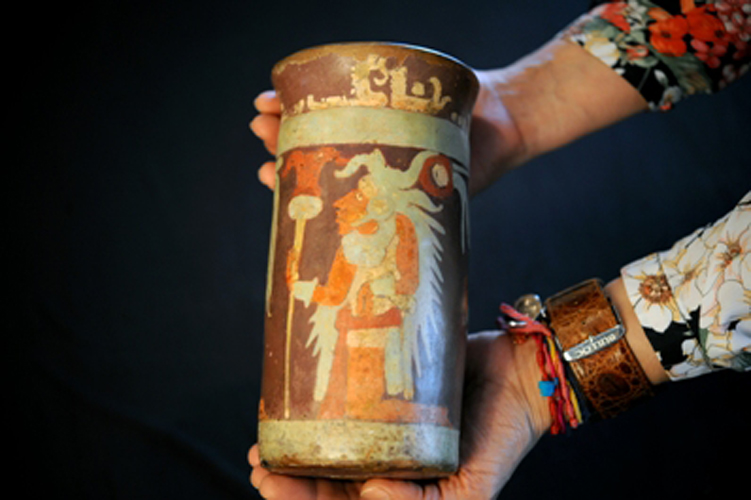
Endangered Maya carved bone subject to import restrictions.  U.S. State Dept.
The U.S. government has renewed and expanded its bilateral agreement with Guatemala protecting jeopardized cultural heritage.  Friday's Federal Register reports that, after a review of the recommendations of the Cultural Property Advisory Committee (CPAC), the U.S. State Department's Assistant Secretary for Educational and Cultural Affairs "determined that the cultural heritage of Guatemala continues to be in jeopardy from pillage of certain archaeological objects and is also in jeopardy from pillage of certain ecclesiastical ethnological materials dating to the Conquest and Colonial Periods of Guatemala (c. A.D. 1524 to 1821)."   The decision by the State Department follows a public hearing held by CPAC in April.

The adopted import restrictions are authorized by the Cultural Property Implementation Act (CPIA) and are effective until September 29, 2017.  The Memorandum of Understanding (MoU) renews import controls on Pre-Columbian archaeological artifacts from Guatemala dating from 2000 B.C. to 1524 A.D.  Moreover, the bilateral agreement  has been broadened to include ecclesiastical objects from approximately 1524 to 1821 A.D.

The United States originally enacted emergency import protections in 1991 and 1994, covering Maya archaeology from Guatemala's Petén region.  The U.S. and Guatemala entered into a bilateral agreement in 1997 that covered pre-Columbian archaeological material. The countries later extended this MoU in 2002 and 2007.

Cultural objects covered by the bilateral agreement may legally pass through the American border when they have either an export permit or proof showing "that they left Guatemala prior to the effective date of the restriction: April 15, 1991, for archaeological material from Petén, and October 3, 1997, for archaeological material from throughout Guatemala," and September 29, 2012 for ecclesiastical material dating from the Conquest and Colonial Periods of Guatemala.

The 1973 Pre-Columbian Monumental or Architectural Sculpture or Murals Statute, meanwhile, also remains in effect.  That federal law forbids importation of designated Pre-Columbian cultural heritage into the U.S., except that monumental or architectural sculpture or murals may be imported when there is either an authorized export license or paperwork showing departure from the source nation before June 1, 1973.

Endangered cultural items protected by either CPIA import controls or the  Pre-Columbian Monumental or Architectural Sculpture or Murals Statute may be detained, seized, and forfeited by American authorities as contraband unless accompanied by an export permit or appropriate proof.  Criminal smugglers may also face potential prosecution.

It is best to speak with a cultural property attorney and/or seek a U.S. Customs ruling when importing cultural heritage from Guatemala.


This post is researched, written, and published on the blog Cultural Heritage Lawyer Rick St. Hilaire at culturalheritagelawyer.blogspot.com. Text copyrighted 2012 by Ricardo A. St. Hilaire, Attorney & Counselor at Law, PLLC. Any unauthorized reproduction or retransmission of this post is prohibited. CONTACT: www.culturalheritagelawyer.com

Mali, Guatemala, and Bulgaria Up for Discussion by CPAC - Public Session Slated for April 24

Lowland Maya mask from Guatemala.
Source: U.S. State Department
The Cultural Property Advisory Committee (CPAC) will meet to consider renewal requests by Mali and Guatemala for Memoranda of Understanding (MoU).  A public session will be held on April 24 to consider extending the bilateral agreements that would continue America's import controls over cultural property originating from these nations.

CPAC also intends to continue its discussion about Bulgaria's earlier request for a bilateral agreement.  That session, according to the Federal Register, will be a confidential meeting authorized by 19 U.S.C. 2605(h), which permits private discussions when "the President or his designee [determines] that the disclosure of matters involved in the Committee’s proceedings would compromise the government’s negotiation objectives or bargaining positions on the negotiations of any agreement authorized by [the CPIA]."

An MoU or bilateral agreement protecting jeopardized archaeological and ethnological objects may be enacted between nations pursuant to Article 9 of the 1970 UNESCO Convention (the Convention on the Means of Prohibiting and Preventing the Illicit Import, Export and Transfer of Ownership of Cultural Property). Congress implemented the treaty by adopting the Cultural Property Implementation Act (CPIA), signed into law by President Ronald Reagan in 1983.  Import protections granted under the CPIA last for five years and may be renewed thereafter.

Head of a Mali figure.
Source: US Department of State.
The United States enacted emergency import controls in 1993 over archaeological material from Mali's Niger River Valley and its Tellem burial caves at Bandiagara. This action led to the 1997 adoption of an MoU between the two nations.  The bilateral agreement was then extended in 2002 and 2007.  The last MoU was broadened to include archaeological objects from the Stone Age to the 1700s.

The United States also took emergency action in 1991 to cover Maya archaeological artifacts from Guatemala's Petén region, extending the protections in 1994.  In 1997, the U.S. and Guatemala entered into a bilateral agreement covering pre-Columbian archaeological material.  The countries extended the MoU in 2002 and 2007.  The 2007 MoU broadened Article 2's provision to include, among among other items, that "the Government of the Republic of Guatemala shall undertake an assessment with regard to improvements in broad areas such as law enforcement, cultural resource management, education, conservation, research, and the national museum system" before the agreement expired in 2012.

To attend or speak at the public session on April 24, you may reserve your place by calling  the Cultural Heritage Center of the Department of State at (202) 632–6301 by 5 p.m. EDT on April 3.  The meeting will be held at 2200 C St., NW. in Washington, DC.

Public comments may be submitted electronically to CPAC at www.regulations.gov and are due April 3 by the end of the day.  Enter docket number DOS-2012-0012 for Mali or docket number DOS-2012-0011 for Guatemala and follow the instructions on the web site.

The committee now only accepts electronic comments unless they are confidential under 19 U.S.C. 2605(i)(1).  Written submissions reasonably determined to qualify for confidentiality may be delivered or mailed to:

Cultural Heritage Center (ECA/P/C)
SA-5, Fifth Floor
Department of State
Washington, DC 20522-0505

Comments submitted to CPAC must address one, some, or all of the four determinations outlined by the CPIA.  Quoting 19 USC 2602, the four determinations are:

(A) [whether] the cultural patrimony of the State Party is in jeopardy from the pillage of archaeological or ethnological materials of the State Party;

(B) [whether] the State Party has taken measures consistent with the Convention to protect its cultural patrimony;

(C) [whether] --

(i) the application of the import restrictions . . . with respect to archaeological or ethnological material of the State Party, if applied in concert with similar restrictions implemented, or to be implemented within a reasonable period of time, by those nations (whether or not State Parties [to the 1970 UNESCO Convention]) individually having a significant import trade in such material, would be of substantial benefit in deterring a serious situation of pillage, and

(ii) remedies less drastic than the application of the restrictions set forth in such section are not available; and

(D) [whether] the application of the import restrictions . . . in the particular circumstances is consistent with the general interest of the international community in the interchange of cultural property among nations for scientific, cultural, and educational purposes.

Tomorrow's Federal Register announcement of the CPAC meeting may be found here.

Seize and Send v. Investigate and Indict: Focusing on Cultural Heritage Criminal Investigations and Prosecutions

ICE and CBP return an illegally
imported artifact to Guatemala.
Courtesy ICE.
Immigration and Customs Enforcement (ICE) and Customs and Border Protection (CBP) held a press conference on February 24 to publicly display the return of pre-Columbian objects to the Guatemalan foreign minister. The objects were recovered both in Houston, Texas in 2009 and from an auction house in Massachusetts in 2011. WJZ television in Baltimore reported that “[n]o arrests in the smuggling cases have been made, although federal agents say investigations are ongoing.”

Authorities are to be lauded for detecting and seizing illegally imported archaeological objects. But the claim that federal officials are continuing their investigation remains to be seen. That is because the primary evidence of possible smuggling has now been returned to Guatemala. The artifacts are no longer preserved for criminal analysis, they are not kept in safekeeping for use in court proceedings, and they are not available for inspection by potential criminal defendants who have a constitutional right to view the government’s evidence in a criminal case.

There appears to be no US Attorney involvement in this case, which is a sign that the matter likely is not being reviewed for possible criminal charges. And Homeland Security does not mention in its official press release that it is pursuing a criminal investigation. At best the agency cautions that “[t]hose involved in the illicit trafficking of cultural property, art and antiquities can face prison terms of up to 20 years, fines and possible restitution to purchasers of the items.“

Those who follow cultural property cases closely are aware that Homeland Security generally implements a seize and send policy with regard to cultural artifacts. While the agency boasts in its latest press statement and elsewhere that “[s]ince 2007, HSI [Homeland Security Investigations] has returned more than 2,500 artifacts to 23 countries …”it is silent about successful cultural property prosecutions. Such prosecutions are rare.

The Cultural Property, Art and Antiquities Investigations Program is carried out by HSI. The program describes its mission on ICE’s web site: “Returning a nation’s looted cultural heritage or stolen artwork, promotes goodwill with foreign governments and citizens, while significantly protecting the world’s cultural heritage and knowledge of past civilizations.” The emphasis is on sending cultural objects to home countries, not on developing cases for criminal prosecution.

It could very well be that the lack of financial or human resources prevents the development of cultural property smuggling cases. It could be too that politics affects agency decision making. Indeed, it may be noteworthy that on the same day of the repatriation of artifacts to Guatemala, Homeland Security Secretary Janet Napolitano announced that she would be traveling to Guatemala City and other Latin American destinations between February 27 and 29. Perhaps prosecutors are rejecting these cases for review. Whatever issue prevents ICE from doing its job to investigate and prepare cases for presentation to a federal grand jury and subsequent criminal prosecution must be resolved.

ICE Director John Morton is right to note “the exceptional investigative work HSI is doing to stop the pilfering and illicit trading of precious art and antiquities from around the world.” ICE has talented investigators. But more must be done to bring the talents of these federal agents to the next level so that their cases serve to provide a meaningful deterrent to archaeological smuggling. Investigators must be permitted to conclude their cases by submitting them to receptive US Attorneys for review and possible indictment. Cases concluded through seizure, forfeiture, and repatriation alone do not have a similar impact on criminal activity.

Sources:
Homeland Security press releases
http://www.ice.gov/news/releases/1202/120224washingtondc.htm
http://www.dhs.gov/ynews/releases/20120224-statement-on-napolitano-trip-to-central-america.shtm

WJV TV
http://baltimore.cbslocal.com/2012/02/24/stolen-ancient-mayan-artifacts-being-returned-to-guatemala/

CONTACT: www.culturalheritagelawyer.com
Blogroll

azplanningforwildlife.com m2tvchannel.com bapedaldaprovjambi.com kreis-dl.net news-1212.com landratsamt-doebeln.net landkreis-doebeln.net canadiangoldreserves.net chicagohearse.com tattooremovalessex.com braziltrade-uae.com 333asia.com calliemacdesigns.com gemdoc.net simplefoodjuiceplus.com postabortionstresssyndrome.com descendingpath.com casadopinhole.net myspeechandlanguage.net sezambook.com rerecognition.info bebetsy.info carsoncitybraces.info summitcardiology.info sanfojiangsi.info trailheadgeararchery.info immigrationconnect.info nhhomeless.info tundradialogues.info ibexretail.com kreis-dl.com agiles-eam.com bestbcgolfcourse.com niittyneito.com yenikapimevlevihanesi.com hnr100.com eplogin.com richard-wagner-festival.com landratsamt-doebeln.com lra-doebeln.com terrecatalane.com thesmarterhybrids.com Political Science,Politics And Religion,Lamp For Home,Internet Media Services,Book Holidays Online,Electric Car Engine,House And Garden Magazine,Fashion Art Music,Allobits Business Finance Solutions,Amelia Island Living,Sectb Business management,Biblepl College And University,Synergysigns Home Furniture,Marketing and Promotion,Meristem Nature,Success Business,Food and Nutrition,New Health Foundation,Real Estate Designer,Chase Auto Loans,Economic and Business Review,Business Insurance Quotes,Gambling Commission,Game and Media Technology,TakingBusinessOpportunities,MedicalCenter,FashionModelling,FashionCelebrity,BusinessMarketing,ComputersandTechnology,SubjectAboutTechnology,Children'sEducation,EconomicsBusinessandFinance,Entertainment,BusinessAccounting,HealthTechnology,AirHealth,BodyHealth,HousingDesigners,ArtsandEntertainment,GamingTournament,ForexEducation,HomeDesignIdea,BeautyClinic Professional Translation Streaming Wizard Alcoholism and Drug Medical Laboratory Commerce Business Educational Kids Play Space Education Home Repair Volunteer Fashion Talent Health and Safety Executive Play Web Games Travel and Surfing Property and Estate Agents Technology Group Solutions Student Service Center Construction Industry Media Center Computer Teny Fashion Home Remodeling Services Inspector Network Car Rentals Leader Dogs Rise Health Systems Business Strategy Consultant
Personal Life Coaching
Company Business Coaching
Entertainment News
Physics and Astronomy
Science and Technology
Cheap Vacation Packages
World Business Academy
Planets Project
Travel and Leisure
Prevent Drug Abuse
Education Certified
Play Kids Games
Legal Defense Fund
Real Estate Strategies
Isolation Globale
Insurance Coverage Law
Rock Hotel and Resorts
Medical Insurance
Healthy Mind and Body
Marjahaan Autokatsastus
Free Sports Authority
Auto Insurance Coverage
Global Technics
Advitium Manufacturing
Professional Core Education
Special Finance Services
Bergen County Contractors
Great Children's Art
Health Supply Company
Social Media Power
Texas House Restaurant
Carbon Consultant
Carbon Expert
Low Carbon
Reset Carbon
Healthcare Commissioning
Virtual Job Tryouts
Ethos Academy (Education)
Intrinsic Schools
Attorney General
Technology Software
Business Plans
Digital Media
High School Resources
Adult Resources
Gamblers Anonymous
Ecuador Real Estate
Software Development
Festival Fashion
Drugs And Alcohol
Food Network Recipes
Journal Human Resources
Games and Technology
Technology Development
Web Resources Express
Payday Loans Bad Credit
Art and Craft
Business and Finance News
Ecological Sciences
Education Resources
Web Design
Music Education
World Resources Institute
Business Health Guide