Showing posts with label repatriation. Show all posts

Arguments Made in Sotheby's Cambodian Statue Case on Motion to Dismiss

The federal district court in Manhattan yesterday heard arguments in the matter of United States Of America v. A 10th Century Cambodian Sandstone Sculpture, Currently Located at Sotheby's In New York, New York.  The United States is seeking the forfeiture of the Duryodhana statue, claimed to have been removed illegally from the Prasat Chen Temple in Koh Ker, Cambodia.

Sotheby's attempted to sell the artifact last spring on behalf of the consignor, Ms. Ruspoli di Poggio Suasa.  But the U.S. government now seeks to repatriate the statue to Cambodia.

Yesterday's argument before Judge George B. Daniels was expected to address the claimants' motion to dismiss and the government's objection.  The court is anticipated to rule on the matter.


This post is researched, written, and published on the blog Cultural Heritage Lawyer Rick St. Hilaire at culturalheritagelawyer.blogspot.com. Text copyrighted 2012 by Ricardo A. St. Hilaire, Attorney & Counselor at Law, PLLC. Any unauthorized reproduction or retransmission of this post is prohibited. CONTACT: www.culturalheritagelawyer.com

Homeland Security Investigations Returns Artifacts to Nigeria - No Arrests or Indictments Announced

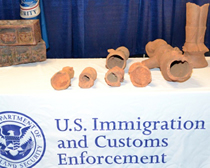
Nok statues repatriated to Nigeria.  ICE
U.S. Immigration and Customs Enforcements (ICE) officials found themselves busy in New York today.  ICE raided a Manhattan storage area linked to an alleged antiquities trafficking network.  Meanwhile, Homeland Security Investigations (HSI) repatriated ten Nok statues and one carved tusk to Nigeria.

James T. Hayes Jr., special agent in charge of HSI New York, commented on the return of the Nigerian cultural objects seized by U.S. Customs and Border Protection:  "Smugglers who thrive on greed place very little interest in the preservation of cultural property when they plunder ancient artifacts to sell to the highest bidder."  No arrests or indictments were announced.

ICE reported in a press statement that "HSI special agents at John F. Kennedy International Airport (JFK) first learned of the stolen Nok statues in April 2010 after receiving information from French customs officials. . . . HSI Chicago had also previously seized two Nok statues and a carved ivory tusk at Chicago O'Hare International Airport.  After an investigation with assistance from French authorities, the Louvre in Paris, Interpol and the International Council of Museums, HSI special agents determined the Nok statues were in fact antiquities and not just handicrafts and personal effects as was diclosed on the importation documents provided to U.S. authorities."

Nigerian Consul General Habib Baba Habu pledged that the "ten figurines and one carved tusk will be returned to the national museum for display, at a ceremony to be presided by the minister of foreign affairs."

Nigeria does not have a bilateral agreement with the United States under the Cultural Property Implementation Act.

This post is researched, written, and published on the blog, Cultural Heritage Lawyer Rick St. Hilaire at http://culturalheritagelawyer.blogspot.com.  Post text copyrighted 2012 by Ricardo A. St. Hilaire, Attorney & Counselor at Law, PLLC.  CONTACT: www.culturalheritagelawyer.com

No Arrests Announced as ICE Officials Seize and Send Cultural Objects to Peru

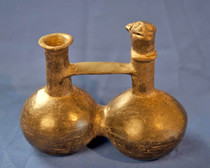
ICE: Artifact returned to Peru on July 12.
United States Immigration and Customs Enforcement (ICE) reported no arrests or indictments during a repatriation ceremony yesterday that returned stolen and smuggled cultural objects to Peru. 

In a press statement, ICE’s Homeland Security Investigations (HSI) said that it mounted an “undercover Internet operation” and recovered the artifacts “in five separate investigations in . . .  New York; West Virginia; Wilmington, Delaware; and Austin and Houston, Texas.”  HSI concluded that the objects were illegally imported into the United States in violation of U.S. customs laws after having been illegally removed from Peru.

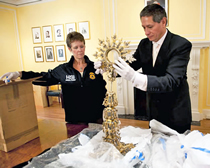
ICE agent watching over a monstrance.
With assistance from the U.S. Department of Justice and INTERPOL, HSI seized and sent to Peru nine 18th century religious paintings, pre-Columbian pottery, an Andean textile, a monstrance, a Moche jar, and a tumi blade.

ICE Director John Morton observed that "[t]he plundering of cultural property is one of the oldest forms of organized cross-border crime and has become a world-wide phenomenon that transcends frontiers.” Deputy Attorney General James Cole added, "Like other criminal acts, cultural property crimes are borderless and require a coordinated law enforcement response among countries.... [The objects] were stolen by those whose selfish acts and greed sought to deprive a people and the public of their cultural treasures."

No mention was made during Thursday's public ceremony held in Washington, DC of any arrests, grand jury investigations, indictments, or continued law enforcement probes into the alleged criminal activity.  HSI's seize and send policy has been critiqued because of its disproportionate focus on the repatriation of cultural objects over needed efforts to deter transnational cultural heritage crime by prosecuting antiquities traffickers when they violate U.S. law.

HSI outlined details of its investigation in its press statement:
“Of the objects returned July 12, two of the Cusco oil paintings – Saint Ignatius of Loyola, and Virgin and Child – were sold at an auction house in Austin. Seven other Peruvian antique paintings were being sold from a Houston gallery. The pre-Columbian Chimu-Inca whistling pot and Andean textile were being sold on eBay. In an undercover Internet operation, HSI special agents in West Virginia targeted sellers of illicit pre-Columbian artifacts operating from this Internet site. The monstrance was listed for sale at Christie's auction house in New York and HSI special agents discovered it was consigned by an art collector associated with museums in Puerto Rico and Denver. HSI's investigation revealed that the monstrance had been stolen from Saint Stephen the Martyr, a small Catholic church in Yaurisque, located in the Cusco region of Peru. The Moche ceramic jar and the bronze ceremonial knife were consigned by an estate trust in order to be sold at an auction house in Madison, N.J., and necessitated grand jury subpoenas issued by the U.S. Attorney's Office for the District of Delaware.”

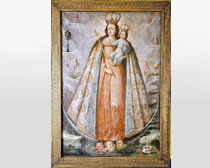
Assistant United States Attorney David Hall from the Delaware U.S. Attorney's Office was responsible for investigating two of the Cusco school paintings involved in the case, according to a statement released by that office.  An image of one of the paintings appears at right.  Hall is a 2010 SAFE (Saving Antiquities for Everyone) Beacon Award winner.

The repatriation ceremony comes one month after the United States renewed import controls covering Peruvian cultural property determined to be in jeopardy from plunder.

Homeland Security's Seize and Send Policy on Display at Repatriation Ceremony

Artifact returned to Italy by ICE.
Courtesy ICE

Immigration and Customs Enforcement (ICE) this week announced successful efforts to combat crime in the United States.  In the last few days, ICE's Homeland Security Investigations (HSI) directorate headlined these results:
  • "9 suspects arrested in HSI probe targeting Fresno-area phony document mills"
  • "637 gang members and associates arrested during Project Nefarious" 
  • "5 indicted for allegedly selling counterfeit goods" 
Yesterday, however, the federal agency announced something other than arrests or indictments.  An April 26, 2012 press release proclaimed, "ICE returns stolen and looted art and antiquities to Italy."

While many of ICE's powerful investigative arms probe violations of federal law and pursue justice through the criminal court system, the Cultural Property, Art and Antiquities Program at HSI continues to repossess artifacts, hold repatriation ceremonies, and ship potential court evidence overseas. Arrests are infrequently announced, and indictments for violating federal smuggling, theft, false statement, or wire transfer laws are rare.

The contrast between ICE's typical approach to cultural property crimes and its customary handling of forfeited documents, human trafficking, counterfeit goods, and other illegal activities is striking.  A few of this week's press releases illustrate:
  • After arresting the nine men for trafficking in forfeiting documents, special agent Clark Settles said that the  "goal in these investigations is to identify and ultimately dismantle the criminal organizations behind these highly lucrative schemes."
  • After 637 gang members and associates were arrested, HSI Executive Associate Director James Dinkins announced that "[t]he goal of Project Nefarious was to identify, locate, arrest, prosecute and remove gang members and associates affiliated with human smuggling and trafficking organizations."
  • After a grand jury indicted five people for selling counterfeit goods, ICE announced that it "plays a leading role in targeting criminal organizations responsible for producing, smuggling and distributing counterfeit products. HSI focuses not only on keeping counterfeit products off our streets, but also on dismantling the criminal organizations behind such illicit activity."
Marble sculpture returned to Italy.
Courtesy ICE
But yesterday's press announcement proclaiming the repatriation of looted and stolen antiquities to Italy simply describes a "ceremony" to return "[t]wo 2,000-year-old ceramic vessels, one Roman marble sculpture, one Renaissance painting and three music sheets from choir books dating back to the 13th century ...."  Authorities did not announce any arrests or indictments despite descriptions of criminal activity by the use of terms such as "looted," "illegally imported," "smuggled," " illicit trafficking," "organized crime," and "stolen."

In other criminal investigations, HSI agents investigate cases, work with prosecutors to develop and sift through evidence, present the results to grand jurors, and hold lawbreakers accountable.  In illegal antiquities trafficking cases, however, Homeland Security Secretary Janet Napolitano said it best during Thursday's ceremony, "We will continue to work to ensure cultural artifacts and treasures that were stolen and entered this country illegally are recovered and returned to their rightful home nations."

This "seize and send" strategy requires rethinking to coincide with the "investigate and indict" mission that other HSI investigations pursue to dismantle and deter criminal activity.

ICE Director John Morton said yesterday that "ICE is serious about reining in art and antiquity thieves, smugglers, and traffickers."  Yet antiquities thieves, smugglers, and traffickers must be brought to trial.  And while ICE poignantly warned in Thursday's press release that anyone "involved in the illicit trafficking of cultural property, art and antiquities can face prison terms of up to 20 years, fines and possible restitution to purchasers of the items," criminals must first be indicted before they can face such consequences in a U.S. district court.  Only then can the "antiquity thieves, smugglers, and traffickers" who are targeted by ICE be held to account for violating federal criminal laws.

CONTACT: www.culturalheritagelawyer.com

Seize and Send v. Investigate and Indict: Focusing on Cultural Heritage Criminal Investigations and Prosecutions

ICE and CBP return an illegally
imported artifact to Guatemala.
Courtesy ICE.
Immigration and Customs Enforcement (ICE) and Customs and Border Protection (CBP) held a press conference on February 24 to publicly display the return of pre-Columbian objects to the Guatemalan foreign minister. The objects were recovered both in Houston, Texas in 2009 and from an auction house in Massachusetts in 2011. WJZ television in Baltimore reported that “[n]o arrests in the smuggling cases have been made, although federal agents say investigations are ongoing.”

Authorities are to be lauded for detecting and seizing illegally imported archaeological objects. But the claim that federal officials are continuing their investigation remains to be seen. That is because the primary evidence of possible smuggling has now been returned to Guatemala. The artifacts are no longer preserved for criminal analysis, they are not kept in safekeeping for use in court proceedings, and they are not available for inspection by potential criminal defendants who have a constitutional right to view the government’s evidence in a criminal case.

There appears to be no US Attorney involvement in this case, which is a sign that the matter likely is not being reviewed for possible criminal charges. And Homeland Security does not mention in its official press release that it is pursuing a criminal investigation. At best the agency cautions that “[t]hose involved in the illicit trafficking of cultural property, art and antiquities can face prison terms of up to 20 years, fines and possible restitution to purchasers of the items.“

Those who follow cultural property cases closely are aware that Homeland Security generally implements a seize and send policy with regard to cultural artifacts. While the agency boasts in its latest press statement and elsewhere that “[s]ince 2007, HSI [Homeland Security Investigations] has returned more than 2,500 artifacts to 23 countries …”it is silent about successful cultural property prosecutions. Such prosecutions are rare.

The Cultural Property, Art and Antiquities Investigations Program is carried out by HSI. The program describes its mission on ICE’s web site: “Returning a nation’s looted cultural heritage or stolen artwork, promotes goodwill with foreign governments and citizens, while significantly protecting the world’s cultural heritage and knowledge of past civilizations.” The emphasis is on sending cultural objects to home countries, not on developing cases for criminal prosecution.

It could very well be that the lack of financial or human resources prevents the development of cultural property smuggling cases. It could be too that politics affects agency decision making. Indeed, it may be noteworthy that on the same day of the repatriation of artifacts to Guatemala, Homeland Security Secretary Janet Napolitano announced that she would be traveling to Guatemala City and other Latin American destinations between February 27 and 29. Perhaps prosecutors are rejecting these cases for review. Whatever issue prevents ICE from doing its job to investigate and prepare cases for presentation to a federal grand jury and subsequent criminal prosecution must be resolved.

ICE Director John Morton is right to note “the exceptional investigative work HSI is doing to stop the pilfering and illicit trading of precious art and antiquities from around the world.” ICE has talented investigators. But more must be done to bring the talents of these federal agents to the next level so that their cases serve to provide a meaningful deterrent to archaeological smuggling. Investigators must be permitted to conclude their cases by submitting them to receptive US Attorneys for review and possible indictment. Cases concluded through seizure, forfeiture, and repatriation alone do not have a similar impact on criminal activity.

Sources:
Homeland Security press releases
http://www.ice.gov/news/releases/1202/120224washingtondc.htm
http://www.dhs.gov/ynews/releases/20120224-statement-on-napolitano-trip-to-central-america.shtm

WJV TV
http://baltimore.cbslocal.com/2012/02/24/stolen-ancient-mayan-artifacts-being-returned-to-guatemala/

CONTACT: www.culturalheritagelawyer.com

Court Forfeits Cristo Portacroce After Italy Does Not File A Claim

The forfeited Cristo Portacroce.
Courtesy ICE
The United States District Court for the Northern District of Florida has ordered the forfeiture of the painting, the Cristo Portacroce Trascinato Da Un Manigoldo.  The court issued the default judgment once the previous possessors, Italy and its Brera Art Gallery, failed to make a claim for the return of the artwork.

The court's ruling was brief:  "Upon Application of the Plaintiff(s) in the above styled cause and having examined the records and there appearing to be no responsive pleadings filed by the defendant(s), default is hereby entered against the Italian Republic, Ministry of Culture, and the Pinacoteca di Brera, on January 3, 2012."

The painting will likely be handed over to the heirs of Federico Gentili di Giuseppe, who filed a claim on December 14, 2011 arguing that they were the lawful owners.  Prosecutors submitted information to the court that the painting was taken from the family by the Nazis during World War II.  Click here for details.

Federal officials seized the Cristo Portacroce in November 2011, which the Mary Brogan Museum of Art and Science in Florida had on loan.  See here for background.

Court papers filed by government lawyers show that the Italian's were aware that the painting's ownership was in dispute.  But the records do not explain why the Italy-Brogan loan agreement did not contemplate legal protection from seizure under the federal law known as Immunity from Seizure Under Judicial Process of Cultural Objects Imported for Temporary Exhibition or Display.

Stolen Art Repatriated to Poland Following Default Judgment in U.S. v. One Julian Falat Painting Entitled “Off to the Hunt” and One Julian Falat Painting Entitled “The Hunt”

U.S. Immigration Customs and Enforcement’s (ICE) Homeland Security Investigations (HSI) and the U.S. Attorney’s Office for the Southern District of New York repatriated two Julian Falat paintings on September 22, transferring them to President BronisÅ‚aw Komorowski of Poland in a ceremony held at the Polish Consulate in New York. American and Polish officials said that the Nazis stole “The Hunt” and “Off to the Hunt” from Warsaw’s Polish National Museum during the era of World War II.

In 2006, the Polish government found the paintings at two auction houses in New York, which removed them from sale when notified. Authorities acquired the paintings this past August after a federal district court in Manhattan entered a default judgment in the U.S. government’s favor. Federal officials then turned the paintings over to Poles.

"No one can ever provide just compensation to the victims of the Nazis' atrocities, but it is very gratifying for our office to play a role in returning the art that they looted during World War II to its rightful owners," said U.S. Attorney Preet Bharara in a statement. "After 60 years, these national treasures will finally be returned to the Polish Government—a repatriation that would not have been possible without their help."

The U.S. Attorney’s Office filed an in rem forfeiture action against the paintings on December 13, 2010 in order to acquire the artworks. (In a court proceeding for civil forfeiture, the defendant is the property, not a person.) In its complaint, the prosecution alleged that there was probable cause for forfeiture. Assistant US Attorney Kan Nawaday specifically described how “Off to the Hunt” was removed from the National Museum without its frame during World War II. A frame for the artwork originally contained an inked inventory mark, the number 345, when the Society for the Encouragement of Fine Arts in Warsaw placed it there in 1904. The frame survives. “The Hunt,” meanwhile, was also transferred to the National Museum when the German SS confiscated the painting. A catalog record and photograph of the artwork still exists.

The Polish government published a catalog of looted art in 1951 following the Second World War. It described both paintings. Since 1989, the Polish government continued to post the loss of “Off to the Hunt” and “The Hunt” on the internet. The paintings surfaced when Christie’s and Doyle New York, respectively, offered them for auction.

The federal complaint explained that an HSI agent spoke with the consignor of “Off to the Hunt,” whose name was supplied to the Polish government by Christie’s. The consignor had no purchase records and no import paperwork, according to the complaint. Additionally, HSI’s own search of customs records could not find any information related to the import.
HSI was also in contact with the attorney for the consignor of “The Hunt.” The federal complaint described how HSI “spoke with employees of Doyle . . . who informed them that the consignor . . . had brought the painting in for appraisal unframed and wrapped in an old sheet. Additionally . . . employees advised that [the consignor] had provided conflicting stories about how she came in possession of the painting.” HSI itself could find no importation records relating to the painting, according to court papers.

The federal forfeiture complaint stated that each Falat painting was valued at $50,000.

The U.S. Attorney’s Office argued that the paintings could be lawfully forfeited under four alternative legal theories. First, the works of art could be forfeited under 18 USC 981(a)(1)(C) because they were proceeds arising from a violation(s) of the National Stolen Property Act. Second, they could be forfeited under 19 USC 1497(a)(1) because there was no declaration of entry made on any customs form when imported into the United States. Third, they could be forfeited pursuant to 19 USC 1595a(C)(1)(a) because there was probable cause to believe that they were imported in violation of the federal smuggling law or the National Stolen Property Act. Fourth, the paintings could be forfeited because there was “probable cause to believe that they were brought to the United States contrary to law, the possessors of the Defendant Paintings [were] aware that they were stolen and are attempting to offer the Defendant Paintings for sale . . . .”

The government won its case by default after the paintings’ possessors failed to contest the forfeiture complaint. The court granted judgment on August 3, 2011.

"Those paintings are two magnificent and very important pieces of art," said Bogdan Zdrojewski, minister of culture and national heritage of Poland. "If you think about all the Falat paintings, these two are definitely the most interesting and most valuable ones," the minister was quoted as saying in a September 22, 2011 ICE press release.

But at least one of the paintings is not one that the Nazis looted, according to assertions made in a July 1, 2011 letter and attachments sent to the federal court by the possessor of “Off to the Hunt.” She wrote that “a technical analysis of my painting put[s] into severe doubt that my painting and [the Polish government’s] lost painting were one and the same.” She objected to the “far-from-thorough ICE investigation and . . . U.S. Civil laws designed to trap criminals and not good-faith possessors of disputed objects . . .” She also wrote of her inability to enlist her insurer or an affordable attorney to help defend the court action.

In letters addressed to NY Senator Charles Schumer dated June 23 and Secretary of State Hillary Clinton dated June 27 (both contained in the public court file) the possessor made a variety of statements, including the following:
• she was the daughter of a Holocaust survivor,
• she inherited “Off to the Hunt” from her father who bought it in Paris before transporting it to the USA in 1948,
• the “lost painting and mine are two originals by the same painter,” and
• it was improper for the government to imply that she and/or her father may have been “bad faith” possessors of the work.

HSI Executive Associate Director James Dinkins, meanwhile, said in a September 2011 press statement that his agency was “deeply gratified to be able to return these cherished paintings that were taken from the people of Poland so long ago.”

Photo courtesy of ICE.

Changing Course: Enhancing Homeland Security's Policy of Seizure and Repatriation with Investigation and Prosecution

Illegal antiquities trafficking is a global business, linked to major transnational crimes such as money laundering. Additionally, cultural property crimes target humanity’s heritage and spirit. In order to successfully tackle crimes against cultural heritage, federal officials must pursue a strategy of investigation and prosecution.

The current policy of seizure and return does not go far enough. To seize a stolen or smuggled artifact at the American border and return it to its country of origin only serves to repatriate the object. Its confiscation and return does little to deter antiquities trafficking since there is minimal consequence to the perpetrators or accomplices. Building legal cases that lead to arrests and prosecutions would provide both specific deterrence and general deterrence.

The seize and return policy maintained by Department of Homeland Security (DHS) recently came into public view when Customs and Border Protection (CPB) and DHS investigators seized two Chinese artifacts illegally crossing America's border at Newark Liberty International Airport around March 3. Eight days later DHS announced the return of fourteen cultural objects to China, many obtained as a result of an enforcement initiative titled Operation Great Wall. The objects repatriated apparently included one of the artifacts seized at Newark Airport, specifically a Tang Dynasty horse. At least four other Chinese cultural objects that were seized in the New York metropolitan area over the past year were returned to China as well.

Typically when law enforcement officials seize the fruits of a crime or contraband they secure the evidence in anticipation of a prosecution. The return of the Tang Dynasty horse sculpture only a few days after federal officials seized it illustrates how smuggled cultural objects are not treated as criminal case evidence. That is to be expected when the primary mission of DHS is to seize and return, not to investigate and prosecute.

US Customs Director Robert Perez articulated this seize and return policy, declaring that federal authorities are "dedicated to intercepting [cultural] items and ensuring their safe return to their rightful owners." DHS’s news release about the repatriation of Chinese artifacts supports this view, highlighting that “2,300 artifacts have been returned to 18 countries since 2007.” While DHS touts the number of seizures and returns of cultural property, its press statement does not boast of any prosecutions or convictions against looters, smugglers, fences, or receivers of illegally stolen or trafficked cultural heritage.

Combating crimes against cultural heritage requires authorities to investigate and prosecute trafficking rings. Effective law enforcement is characterized by thoughtful investigation, careful handling of physical evidence, and assembly of evidence for review and use by prosecutors. While seizing and repatriating illegally smuggled artifacts serves some purpose to curb antiquities trafficking, federal officials cannot be credited with performing a thorough job if this remains the sole accomplishment.

Immigrations and Customs Enforcement investigators and Customs and Border Protection agents are skilled law enforcement officers who are capable of combating antiquities trafficking effectively. We need to call on DHS policymakers to directly engage illegal antiquities networks by adopting a policy of investigation and prosecution that enhances the existing policy of seizure and repatriation.

Sources:
www.ice.gov/news/releases/1103/110311washingtondc.htm

http://articles.cnn.com/2011-03-03/justice/new.jersey.artifacts.seized_1_newark-airport-antiquities-chinese-government?_s=PM:CRIME

Blogroll

azplanningforwildlife.com m2tvchannel.com bapedaldaprovjambi.com kreis-dl.net news-1212.com landratsamt-doebeln.net landkreis-doebeln.net canadiangoldreserves.net chicagohearse.com tattooremovalessex.com braziltrade-uae.com 333asia.com calliemacdesigns.com gemdoc.net simplefoodjuiceplus.com postabortionstresssyndrome.com descendingpath.com casadopinhole.net myspeechandlanguage.net sezambook.com rerecognition.info bebetsy.info carsoncitybraces.info summitcardiology.info sanfojiangsi.info trailheadgeararchery.info immigrationconnect.info nhhomeless.info tundradialogues.info ibexretail.com kreis-dl.com agiles-eam.com bestbcgolfcourse.com niittyneito.com yenikapimevlevihanesi.com hnr100.com eplogin.com richard-wagner-festival.com landratsamt-doebeln.com lra-doebeln.com terrecatalane.com thesmarterhybrids.com Political Science,Politics And Religion,Lamp For Home,Internet Media Services,Book Holidays Online,Electric Car Engine,House And Garden Magazine,Fashion Art Music,Allobits Business Finance Solutions,Amelia Island Living,Sectb Business management,Biblepl College And University,Synergysigns Home Furniture,Marketing and Promotion,Meristem Nature,Success Business,Food and Nutrition,New Health Foundation,Real Estate Designer,Chase Auto Loans,Economic and Business Review,Business Insurance Quotes,Gambling Commission,Game and Media Technology,TakingBusinessOpportunities,MedicalCenter,FashionModelling,FashionCelebrity,BusinessMarketing,ComputersandTechnology,SubjectAboutTechnology,Children'sEducation,EconomicsBusinessandFinance,Entertainment,BusinessAccounting,HealthTechnology,AirHealth,BodyHealth,HousingDesigners,ArtsandEntertainment,GamingTournament,ForexEducation,HomeDesignIdea,BeautyClinic Professional Translation Streaming Wizard Alcoholism and Drug Medical Laboratory Commerce Business Educational Kids Play Space Education Home Repair Volunteer Fashion Talent Health and Safety Executive Play Web Games Travel and Surfing Property and Estate Agents Technology Group Solutions Student Service Center Construction Industry Media Center Computer Teny Fashion Home Remodeling Services Inspector Network Car Rentals Leader Dogs Rise Health Systems Business Strategy Consultant
Personal Life Coaching
Company Business Coaching
Entertainment News
Physics and Astronomy
Science and Technology
Cheap Vacation Packages
World Business Academy
Planets Project
Travel and Leisure
Prevent Drug Abuse
Education Certified
Play Kids Games
Legal Defense Fund
Real Estate Strategies
Isolation Globale
Insurance Coverage Law
Rock Hotel and Resorts
Medical Insurance
Healthy Mind and Body
Marjahaan Autokatsastus
Free Sports Authority
Auto Insurance Coverage
Global Technics
Advitium Manufacturing
Professional Core Education
Special Finance Services
Bergen County Contractors
Great Children's Art
Health Supply Company
Social Media Power
Texas House Restaurant
Carbon Consultant
Carbon Expert
Low Carbon
Reset Carbon
Healthcare Commissioning
Virtual Job Tryouts
Ethos Academy (Education)
Intrinsic Schools
Attorney General
Technology Software
Business Plans
Digital Media
High School Resources
Adult Resources
Gamblers Anonymous
Ecuador Real Estate
Software Development
Festival Fashion
Drugs And Alcohol
Food Network Recipes
Journal Human Resources
Games and Technology
Technology Development
Web Resources Express
Payday Loans Bad Credit
Art and Craft
Business and Finance News
Ecological Sciences
Education Resources
Web Design
Music Education
World Resources Institute
Business Health Guide