Showing posts with label seizure. Show all posts

Egyptian Coffins Successfully Detected and Recovered by Customs in Texas - Question of Proper Seizure Authority Remains - Updated August 10, 2012

Homeland Security's U.S. Customs and Border Protection (CBP) agency today announced the seizure of "two priceless Egyptian sarcophagi-type artifacts."  A CBP officer at the World Trade Bridge on the border with Mexico in Laredo, Texas is credited with the discovery that successfully recovered the pharaonic-era coffins.

No arrests were made and the transporter(s) has not been identified.  Meanwhile, the suggested legal authority given by CBP for seizing the coffins appears questionable even though there are legal arguments available that would support the seizure of the artifacts.

The coffins did not have export permits from Egypt.  "Working in coordination with HSI [Homeland Security Investigations] and with Office of Assistant Chief Counsel, CBP on July 9 determined that the artifacts would be seized due to a lack of export documentation to substantiate legal exportation of the artifacts from Egypt," CBP says in a press statement.

But the United States is unable to enforce a foreign nation's export laws.  CBP incorrectly explains in its press release that "[t]hrough the Convention on Cultural Property Implementation Act, the United States entered into a cultural property agreement with the Egyptian government to help protect archaeological and ethnological materials through import controls."  The United States and Egypt, however, do not have a bilateral agreement or Memorandum of Understanding (MoU) pursuant to the Cultural Property Implementation Act (CPIA).

[Sidebar: The CPIA is the federal law that implements in the U.S. the 1970 UNESCO Convention (the United Nations Educational, Scientific and Cultural Organization Convention on the Means of Prohibiting and Preventing the Illicit Import, Export and Transfer of Ownership of Cultural Property).  It permits the U.S. to enact import protections and seize endangered cultural objects coming from nations which have a bilateral agreement with America.]

Last year, CBP authorities in Chicago misapplied the law in a case where officers seized a Nayarit figurine from Mexico.  The seizure was reportedly made on the basis of a violation of the CPIA because it was presumed that the United States and Mexico had a bilateral agreement in force under the CPIA.  But the U.S. and Mexico did not (and still do not) have such an agreement in place

Federal officials potentially could rely on the CPIA to seize the Egyptian coffins if they were stolen from a museum after January 12, 1983 and the artifacts were inventoried.  But CBP does not report that the coffins were unlawfully taken from a cultural institution in Egypt.

Federal authorities may choose to rely on alternative legal arguments, nevertheless, to seize, forfeit, and return the coffins to Egypt.  These legal theories are outlined in a 2011 blog post entitled Reclaiming Trafficked Egyptian Cultural Objects.

Instead of returning the coffins right away, the authorities could also choose to secure the coffins as evidence while they investigate and potentially indict suspects for possible violations of the law

CBP tells how the customs officer in Laredo "selected a shipment manifested as Egyptian sculptures for an enforcement examination. In the course of their examination, CBP officers discovered that the shipment included possible Egyptian antiquities . . . ."  CBP reports that it "had recently been made aware of possible stolen artifacts of Egyptian origin,"  It is unknown if the information the agency received was generic--such as the ICOM Red List--or whether CBP received specific intelligence about the shipment traveling through Texas.  In either case, the customs official at the border remained alert so as to intercept the cultural items.

CBP is to be commended for its detection and interdiction of the contraband Egyptian coffins.  Yet it is important that the agency accurately cite the proper legal authority for the seizure of the artifacts.  That is because the public relies on government officials for guidance so as to remain compliant with the law and to avoid the potential loss of property.

[UPDATE August 10, 2012: CBP has now revised its web-posted press release by striking any reference to the seizure of the Egyptian coffins under the authority of the federal Cultural Property Implementation Act. The agency finds support for the seizure by stating that neither sarcophagus had any accompanying export paperwork from Egypt.

CBP should clarify that it is not the lack of foreign regulatory paperwork that justifies the seizure of the cultural objects--although the lack of an export permit from Egypt can be an important piece of evidence to federal enforcement authorities--it is that American import and criminal laws are triggered by Egypt's legal ownership claims to the coffins.  The sarcophagi, for example, can be seized under 19 USC 1595a's "contrary to law" provision where there is probable cause to believe that the coffins constitute stolen property in the United States under the McClain/Schultz doctrine's interpretation of the National Stolen Property Act. To simplify, stolen property brought into the United States from abroad is contraband under federal law that may be seized by CBP officers and returned to the legal owner.]

CBP's press release may be found here.  Photos of the seized Egyptian coffins courtesy of CBP.

This post is researched, written, and published on the blog Cultural Heritage Lawyer Rick St. Hilaire at http://culturalheritagelawyer.blogspot.com. Text copyrighted 2012 by Ricardo A. St. Hilaire, Attorney & Counselor at Law, PLLC. CONTACT: www.culturalheritagelawyer.com

Unveiling the Import and Export of Trafficked Heritage: The Kapoor/Art of the Past Case Examined

Source: Tamil Nadu Police
International antiquities trafficking networks will utilize legitimate and illegitimate shipping methods to advance cultural heritage crimes.  That is why a consideration of the solutions to combat illegal antiquities trafficking must examine how objects are imported and exported. The current American and Indian investigations into Subhash Kapoor offer a timely case study into the alleged transnational smuggling of cultural heritage.

Kapoor is currently under arrest in India, charged with idol trafficking.  He is an American citizen who owns Art of the Past gallery and Nimbus Import Export on Madison Avenue in New York.  Click here and here for further details.

Immigration and Customs Enforcement (ICE) reports that Homeland Security Investigations' (HSI) involvement in the case began in February 2007 after having been contacted by the government of India.  "The Indian Consulate advised HSI that an import and export company was expecting the arrival of a shipment containing seven crates manifested as 'Marble Garden Table Sets.' The consulate believed these crates contained stolen Indian antiquities. This merchandize (sic) was allegedly imported by Kapoor."

APL Alexandrite
The bill of lading reveals that the shipment weighed 1400 kg (3086 lb.) and occupied seven containers. The merchandise is described as "Garden Table Set."  The shipper is listed as Palae Knit Exports in Ludhianda, India.  The shipment left Jawaharlal Nehru, India on the Singapore flagged ship, APL Alexandrite, before arriving at the port of New York on February 10, 2007. The receiver of the goods is listed as Nimbus Import Export, Inc. with an address in West Nyack, NY. (It is important to note that neither the shipper nor the shipping company are implicated in any wrongdoing.)

A few interesting highlights about this shipment, which may have alerted customs agents at the border, are that:
  • it was the weight of a subcompact car and not a garden table set;
  • the exporter was a garments and textiles supplier and not an outdoor furniture or stone supplier;
  • Nimbus Import Export, Inc. is Kapoor's import company, and he owns an antiquities shop rather than a garden furniture company; and
  • the shipping address of the company is not the same as the one listed in official New York State records. (As reported on July 18 on this blog, Nimbus Import Export's officially listed address is in Manhattan, at the same place as Kapoor's Art of the Past gallery, and not in West Nyack, NY.)
Comparing additional import records associated with Nimbus to information collected by Indian police yields further information about how cultural artifacts may have entered the United States.  Bills of lading explain that Nimbus Import Export received the following listed merchandise from Everstar International Services since 2006 (spelling errors in the original electronic bills of lading):
  • Handicraft Items (brass Ganesh, Brass Krishna, Brass Deve, Brass Nandhi) - U.S. arrival: 2/28/06
  • Indian Hand Made Artistic Handicraft Articles -  U.S. arrival: 6/10/06
  • Indian Hand Made Artistic Handictaft Artickes (brass Ganesh,brass Deepalakshmi,brass Murugan) -  U.S. arrival: 8/5/06
  • India Hand Made Artistic Handicraft Articles -  U.S. arrival: 9/13/06
  • Indian Artistic Handicraft -  U.S. arrival: 12/27/06
A 2009 document, published by the Idol Wing of the Tamil Nadu Police Department and which details the alleged trafficking of idols to the United States, reports that arrested export agent Packia Kumar ran a company called Ever Star International Services.  Everstar  (as it is spelled in the import records) purportedly exported newly crafted statues mixed with illicit commodities.  The report says that "part of the stole[n] antique idols were mingled with [n]ew metal idols. (Like 2 or 3 stolen idols with 4 or 5 new metal idols) and presented the export invoice with a false affidavit that all the idols in the consignment were recently manufactured."  The report goes on to describe how the export certificates listed the idols as  "Artistic Handicraft Products," and names Nimbus as the receiver of the alleged illegal exports.  This information confirms the information listed in the bills of lading outlined above.

Meanwhile, ICE describes the types of cultural objects that made their way to Kapoor in the United States, which went undetected by customs officials at the border (except for those objects perhaps recovered following the 2007 tip-off by Indian authorities, but it is unclear from ICE's press release what action the agency took in response to the call received from the Indian consulate). "By the end of January 2012, HSI special agents had seized dozens of antiquities" in New York, according to a July 26 ICE press release, including
  • a 1600 pound Buddha head
  • a life sized stone figure weighing 500 pounds
  • three Chola period bronze sculptures, depicting Uma Parvati, Sivagami Amman, and Murugan
  • A sandstone statue depicting Kubera, chief of the Yakshas, from the Indian Gupta period;
  • a grey schist statue depicting Herkules-Vajrapani from the Kandahran Kushan period; and
  • a sculpture depicting Shakyamuni Buddham from the Indian Chola period.
"This investigation has uncovered that Kapoor allegedly created false provenances to disguise the histories of his illicit antiquities," concludes ICE.

Art of the Past gallery in New York posts "Closed for Inventory,"
one day after ICE raided Subhash Kapoor's storage units.
Examining the import and export methods surrounding the Kapoor case not only can aid police in the United States and India in their current investigations targeting the alleged idol thief, but it can help policymakers, criminologists, and scholars think about better ways to detect, uncover, interdict, and prosecute future crimes of heritage trafficking. Indeed, the Kapoor case may even be the one that prompts stakeholders to give serious consideration to WikiLoot, a proposal that Chasing Aphrodite author Jason Felch describes as "an initiative to crowd-source the fight against the black market in looted antiquities."

Meanwhile, as museums and collectors hopefully research their collections to discover whether they own pieces acquired from Kapoor, they should take note that even modern and legitimately imported items in their collections may have been used to mask potentially illegal shipments of cultural objects.

This post is researched, written, and published on the blog Cultural Heritage Lawyer Rick St. Hilaire at http://culturalheritagelawyer.blogspot.com. Text copyrighted 2012 by Ricardo A. St. Hilaire, Attorney & Counselor at Law, PLLC. CONTACT: www.culturalheritagelawyer.com

U.S. Investigators Retrieve Cultural Objects from Kapoor's Rented Storage in New York - What Might Happen Next?

Source: ICE
American authorities participating in the Subhash Kapoor investigation today seized cultural and religious artifacts from a storage facility in Manhattan, according to the New York Post.  The newspaper reports that Immigration and Customs Enforcement (ICE) took away several dozen pieces.

Kapoor, an American citizen and owner of both Art of the Past gallery and Nimbus Import Export in Manhattan, is accused by police in India of involvement in antiquities trafficking.  Artifacts from Kapoor are reportedly located in American museums' collections.

The New York Post article describes today's raid and tells about a prior seizure of artifacts: 

"ICE said the probe into Kapoor had previously results in the seizure of dozens of antiquities worth nearly $10 million, including a five-foot tall head of Buddha weighing about 1,600 pounds and a life-sized stone figure weighing about 500 pounds. 'Both items were also seized from a storage unit allegedly leased by Kapoor in New York,' ICE said.

"ICE said that some of the artifacts previously seized in the probe had been displayed in 'major international museums worldwide,' and that other pieces that match those listed as stolen 'are still openly on display in some museums.'

"ICE also said that the Indian Consulate in New York contacted Homeland Security investigators in February 2007 asking for help in a probe of smuggling of Indian antiquities into New York."

It is unknown whether the raids in New York are part of a federal investigation into violations of U.S. criminal and/or import laws, or whether ICE executed the search warrants simply to support the investigation and prosecution of Kapoor in India.  In either case, federal authorities may be contacting museums across the United States that have acquired objects from Kapoor.  Forfeiture actions and/or search warrants may be forthcoming if Homeland Security Investigations (HSI) develops probable cause to believe that accessioned objects may be linked to illegal artifacts trafficking.

The New York Post article appears here in its entirety.

UPDATE 7/26/12: The New York Times is now reporting that the "Manhattan District Attorney’s office issued an arrest warrant for the dealer, Subhash Kapoor, on charges of possessing stolen property."

It should be remembered that prosecutors applying New York state law recently charged and convicted Arnold Peter Weiss, even as federal authorities worked with the Manhattan District Attorney's office to investigate the coin case.  This example of federal-state cooperation may be taking place now in the Kapoor case.  An arrest warrant issued for Kapoor by a county prosecutor's office (the New York County District Attorney, a.k.a. the Manhattan District Attorney) may signal the Manhattan DA's increased determination to deploy state law to combat culture crime.  In fact, District Attorney Cyrus Vance, Jr. recently concluded a prosecution that convicted ivory dealers under New York criminal law.  That case saw a collaborative investigation between the DA's office, the state Department of Environmental Conservation (DEC), and the federal United States Fish and Wildlife Service (USF&W).

Federal-state cooperation and the use of state criminal law--as opposed to federal criminal law--to prosecute international antiquities trafficking may be taking shape in New York City, which is the heart of the antiquities market.

The United States and India have an extradition treaty.

UPDATE 7/26/12: NBC4 in New York has video of the raid.


View more videos at: http://nbcnewyork.com.

This post is researched, written, and published on the blog Cultural Heritage Lawyer Rick St. Hilaire at http://culturalheritagelawyer.blogspot.com.  Text copyrighted 2012 Ricardo A. St. Hilaire, Attorney & Counselor at Law, PLLC.  CONTACT: www.culturalheritagelawyer.com

No Arrests Announced as ICE Officials Seize and Send Cultural Objects to Peru

ICE: Artifact returned to Peru on July 12.
United States Immigration and Customs Enforcement (ICE) reported no arrests or indictments during a repatriation ceremony yesterday that returned stolen and smuggled cultural objects to Peru. 

In a press statement, ICE’s Homeland Security Investigations (HSI) said that it mounted an “undercover Internet operation” and recovered the artifacts “in five separate investigations in . . .  New York; West Virginia; Wilmington, Delaware; and Austin and Houston, Texas.”  HSI concluded that the objects were illegally imported into the United States in violation of U.S. customs laws after having been illegally removed from Peru.

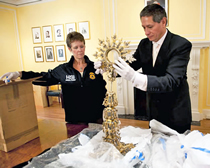
ICE agent watching over a monstrance.
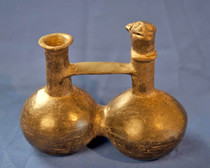
With assistance from the U.S. Department of Justice and INTERPOL, HSI seized and sent to Peru nine 18th century religious paintings, pre-Columbian pottery, an Andean textile, a monstrance, a Moche jar, and a tumi blade.

ICE Director John Morton observed that "[t]he plundering of cultural property is one of the oldest forms of organized cross-border crime and has become a world-wide phenomenon that transcends frontiers.” Deputy Attorney General James Cole added, "Like other criminal acts, cultural property crimes are borderless and require a coordinated law enforcement response among countries.... [The objects] were stolen by those whose selfish acts and greed sought to deprive a people and the public of their cultural treasures."

No mention was made during Thursday's public ceremony held in Washington, DC of any arrests, grand jury investigations, indictments, or continued law enforcement probes into the alleged criminal activity.  HSI's seize and send policy has been critiqued because of its disproportionate focus on the repatriation of cultural objects over needed efforts to deter transnational cultural heritage crime by prosecuting antiquities traffickers when they violate U.S. law.

HSI outlined details of its investigation in its press statement:
“Of the objects returned July 12, two of the Cusco oil paintings – Saint Ignatius of Loyola, and Virgin and Child – were sold at an auction house in Austin. Seven other Peruvian antique paintings were being sold from a Houston gallery. The pre-Columbian Chimu-Inca whistling pot and Andean textile were being sold on eBay. In an undercover Internet operation, HSI special agents in West Virginia targeted sellers of illicit pre-Columbian artifacts operating from this Internet site. The monstrance was listed for sale at Christie's auction house in New York and HSI special agents discovered it was consigned by an art collector associated with museums in Puerto Rico and Denver. HSI's investigation revealed that the monstrance had been stolen from Saint Stephen the Martyr, a small Catholic church in Yaurisque, located in the Cusco region of Peru. The Moche ceramic jar and the bronze ceremonial knife were consigned by an estate trust in order to be sold at an auction house in Madison, N.J., and necessitated grand jury subpoenas issued by the U.S. Attorney's Office for the District of Delaware.”

Assistant United States Attorney David Hall from the Delaware U.S. Attorney's Office was responsible for investigating two of the Cusco school paintings involved in the case, according to a statement released by that office.  An image of one of the paintings appears at right.  Hall is a 2010 SAFE (Saving Antiquities for Everyone) Beacon Award winner.

The repatriation ceremony comes one month after the United States renewed import controls covering Peruvian cultural property determined to be in jeopardy from plunder.

Sotheby's Asks Federal Court to Dismiss Forfeiture Case Against Cambodian Statue

Sotheby's auction house and Ruspoli di Poggio Suasa yesterday filed a motion to dismiss the forfeiture case against a Khmer statue.  U.S. Attorney Preet Bharara brought the seizure and forfeiture action of United States Of America v. A 10th Century Cambodian Sandstone Sculpture, Currently Located at Sotheby's In New York, New York on April 4. The government's complaint alleges that the statue, which was put up for sale at the auction house this spring, was "illicitly removed from the Prasat Chen Temple at the historic and archeological site of Koh Ker, Preah Vihear Province, Cambodia."  The case is in the federal district court for the southern district of New York.

Prosecutors cite alternative theories to advance their forfeiture claim. They write that "there is probable cause to believe that the [statue] is stolen property introduced into the United States contrary to law" in violation of customs law 19 U.S.C. §1595a(c).  Prosecutors alternatively say that the statue is subject to forfeiture under the criminal anti-smuggling law 18 U.S.C. § 545 because there is probable cause to believe that the statue "has knowingly been brought into the United States contrary to law."  And prosecutors maintain that the statue may be forfeited as proceeds of a theft crime under 18 U.S.C. § 981(a)(1)(C) and the National Stolen Property Act.

Ms. Ruspoli di Poggio Suasa says that her husband bought the Cambodian statue in 1975 in London "in good faith in an arms-length, open market transaction" and that "[t]he couple brought the Statue to their home in Belgium, [where] it remained on display until it was shipped to New York in 2010 to be sold at auction by claimant Sotheby’s, Inc."  Both Sotheby's and Ruspoli di Poggio Suasa are the named claimants in the government's forfeiture action.

The claimants' June 5 motion to dismiss makes the three-pronged argument that "[t]he Government has not alleged sufficient facts to establish a reasonable basis to believe it could meet its burden of proof at trial to show that the Statue was stolen from Cambodia, that it remained stolen at the time of import, and that it was known to be stolen by either Sotheby’s or Ms. Ruspoli."

The claimants challenge the prosecution's assertion that the statue was stolen from Cambodia.  They contend that colonial laws from 1900 and 1925, arguably vesting ownership of the statue in Cambodia, are ambiguous.  "Because the Colonial Decrees do not clearly and unambiguously declare that Cambodia owns the Statue, as a matter of law the removal of the Statue from Cambodia did not render the Statue stolen property," the claimants' attorneys argue.

The decrees were not even enforced, the attorneys suggest: "The [government's] Complaint is silent on whether Cambodia has ever before, in any context, enforced the Colonial Decrees as granting the state ownership of antiquities. Emails incorporated by reference in the Complaint reflect that Cambodia’s Culture Minister did not intend to seek to reclaim objects that left Cambodia 'years ago,' . . . before Cambodia’s 1992 law expressly nationalized antiquities. Another document incorporated by reference in the Complaint shows that Cambodia recognizes that the Companion Statue—which is similarly situated with regard to the Colonial Decrees cited by the Government—'belongs to' a Los Angeles museum [the Pasadena based Norton Simon Museum]." (Citations omitted).

The claimants argue that "[e]ven an apparently clear foreign law does not vest ownership if the foreign state has not actually enforced its own law as granting it title. . . . This rule prevents a country unwilling to take the politically unpopular step of seizing antiquities from its own people from asking this country [the U.S.] to do so on its behalf. It also prevents a country from 'rediscovering' laws that have previously not been enforced, thereby unsettling the reasonable expectations that have developed about the meaning of those laws."

The claimants additionally contend that there is no evidence showing that the statue was taken without Cambodia's permission.  "An essential element in proving that the Statue is stolen is establishing that its removal was without the permission of appropriate government authorities." They compare the case to the government's failed effort in federal district court to forfeit the mummy mask of Ka Nefer Nefer located at the St. Louis Art Museum:  "In Ka-Nefer-Nefer, the Government at least had evidence that the statue was once in the foreign state’s actual possession and that there was no record of a subsequent sale or gift. Here,the Government has not alleged that the Statue was ever in the actual possession of the Cambodian government, and the Government makes no allegation of the absence of gift or sale records. Nor, in any event, would the absence of such records be probative, given the passage of time, the intervening turmoil in Cambodia, and the widespread destruction of property records."

The claimants further declare that the government is unable to show that the statue was in Cambodia at the time the colonial decrees vesting title of the statue in Cambodia were enacted. "The Colonial Decrees on which the Government relies are only relevant if the Statue was still in Cambodia after 1900. . . . The Complaint, however, cites and incorporates powerful evidence that the Statue was not in Cambodia at the relevant time." (Citations omitted).  That evidence is the Parmentier survey.  The claimants' attorneys write that "[t]he Parmentier Survey, published in 1939, devotes five pages to a detailed description of the Prasat Chen temple, including the Western Gopura where the Statue supposedly stood, but contains no reference at all to the large and imposing stone Statue (or its companion). The only reasonable conclusion is that the Statue was not at Koh Ker when the Parmentier Survey was conducted."

The claimants' lawyers argue that "[e]ven if the Government has pleaded sufficient facts to establish that the Statue’s removal from Cambodia constituted theft (which it has not), the Complaint must still be dismissed for the independent reason that the Government has not met its burden of alleging facts showing the Statue remained stolen at the time of import."  The attorneys maintain that Sotheby's imported the statue legally, saying that "the assertion that Sotheby’s imported property it knew was stolen is, on its face, wholly implausible. Sotheby’s, after all, fully and accurately described the Statue to the U.S. Customs Service at the time it was imported, put the Statue on the cover of the auction catalogue it circulated publicly around the world, accurately described the Statue’s provenance in that catalogue, and disclosed its intent to sell the Statue to the Cambodian Minister of Culture months in advance of the planned sale. Those are hardly the acts of a 'fence' knowingly selling stolen loot." (Citations omitted). The attorneys add:

"[Sotheby's] would have to have known at the time of import into the United States that Cambodian law in effect when the Statue was still in Cambodia gave that country title to the Statue. That is, Sotheby’s would have had to anticipate that Cambodia and the U.S. Government would take the position that a tangled, unclear patchwork of French colonial texts—no longer anywhere on the code books of the modern nation of Cambodia—decreed the Statue to be state property within the rules set down by McClain and Schultz. Yet the Colonial Decrees the Government cites are sufficiently obscure that even the Government has been unable to locate a fully legible version of the central decree on which it relies—the 1900 Colonial Decree—which it appears in any event was itself subsequently declared illegal."

[Author's sidebar: the McClain and Schultz cases stand for the proposition that a foreign patrimony law that clearly vests legal title in a cultural object may be used as a basis to trigger prosecution in the United States under the National Stolen Property Act in cases involving those who criminally receive property of another.]

Finally, the claimants object to the assertion that they knew the statue was currently stolen.  The government cited a June 1 email by a scholar who advised Sotheby's that the statue was "definitely stolen."  The attorneys for the claimants express that "the Government bears the burden of proving its case by a preponderance of the evidence. The June 1 email, however, is insufficient to create the required reasonable basis to believe the Government will be able to meet its burden at trial."  The lawyers argue:

"First, the view expressed in the Art Historian’s email—that the Statue is 'definitely stolen' because the feet of the Companion Statue were found at Prasat Chen—is a non sequitor as a legal matter. As the law set forth above makes clear, knowing the place of origin is but one piece of a complex puzzle necessary to assessing whether an antiquity is stolen in the legal sense. It is hardly reasonable to think that Sotheby’s—which the Complaint alleges (at ¶ 18) had both a Worldwide Compliance Department and a Worldwide Legal Department tasked with dealing with such issues—would have formed its belief about whether this Statue was stolen based on the unsolicited opinion of a free-lance Art Historian who offered no view on such critical questions as when the Statue left Cambodia, who owned it under Cambodian law at that time, or what was the significance of the 1975 London sale. And, more importantly, even if the June 1 email had some modest force standing alone, it is completely undercut when one considers the subsequent emails incorporated by reference in the Complaint regarding what the Art Historian said and did shortly thereafter."

Further arguing their point, the claimants' attorneys submit::

"In late June, after traveling to Cambodia and speaking to Cambodia’s Minister of Culture, the Art Historian changed her opinion and retracted her concern that the Statue was stolen. As the Art Historian’s emails to Sotheby’s reflect, the Minister of Culture advised her that his focus was 'to stop anything from being exported from Cambodia now, not to go after pieces that left years ago when there were no restrictions.' He also assured her that Cambodia had no intention of seeking to reclaim the Companion Statue—a telling fact since (a) the Cambodians knew the Companion Statue’s feet had been found at Prasat Chen, and (b) the Companion Statue had a similar known provenance, having been sold by Spink [the London antiquities dealer] several years after the Statue. This new information both revealed that Cambodia was not actively enforcing the Colonial Decrees as vesting title . . . (because they did not plan to attempt to reclaim a work with similar provenance), and undermined any characterization of the Statue as stolen (since it was removed 'years ago when there were no restrictions'). It is hardly surprising that the Art Historian changed her mind, stating that: 'I think that Sotheby [sic] can therefore go ahead and plan to sell' the Statue, and that she 'think[s] that legally and ethically [Sotheby’s] can happily sell the piece.' Repeatedly thereafter, the Art Historian reiterated via email her view that Sotheby’s could lawfully sell the Statue, including: 'It was acquired legally, there should be no problem' and 'The piece was legally obtained, so can be legally sold.'" (Citations omitted).

The claimants conclude by saying that "the Government may not seize property by inventing new interpretations of colonial laws long since consigned to dusty archives, while ignoring the archeological record, settled law, and compelling indicia of good faith."

UPDATE August 2012: See the government's objection to the motion to dismiss.

CONTACT: http://www.culturalheritagelawyer.com/

Homeland Security's Seize and Send Policy on Display at Repatriation Ceremony

Artifact returned to Italy by ICE.
Courtesy ICE

Immigration and Customs Enforcement (ICE) this week announced successful efforts to combat crime in the United States.  In the last few days, ICE's Homeland Security Investigations (HSI) directorate headlined these results:
  • "9 suspects arrested in HSI probe targeting Fresno-area phony document mills"
  • "637 gang members and associates arrested during Project Nefarious" 
  • "5 indicted for allegedly selling counterfeit goods" 
Yesterday, however, the federal agency announced something other than arrests or indictments.  An April 26, 2012 press release proclaimed, "ICE returns stolen and looted art and antiquities to Italy."

While many of ICE's powerful investigative arms probe violations of federal law and pursue justice through the criminal court system, the Cultural Property, Art and Antiquities Program at HSI continues to repossess artifacts, hold repatriation ceremonies, and ship potential court evidence overseas. Arrests are infrequently announced, and indictments for violating federal smuggling, theft, false statement, or wire transfer laws are rare.

The contrast between ICE's typical approach to cultural property crimes and its customary handling of forfeited documents, human trafficking, counterfeit goods, and other illegal activities is striking.  A few of this week's press releases illustrate:
  • After arresting the nine men for trafficking in forfeiting documents, special agent Clark Settles said that the  "goal in these investigations is to identify and ultimately dismantle the criminal organizations behind these highly lucrative schemes."
  • After 637 gang members and associates were arrested, HSI Executive Associate Director James Dinkins announced that "[t]he goal of Project Nefarious was to identify, locate, arrest, prosecute and remove gang members and associates affiliated with human smuggling and trafficking organizations."
  • After a grand jury indicted five people for selling counterfeit goods, ICE announced that it "plays a leading role in targeting criminal organizations responsible for producing, smuggling and distributing counterfeit products. HSI focuses not only on keeping counterfeit products off our streets, but also on dismantling the criminal organizations behind such illicit activity."
Marble sculpture returned to Italy.
Courtesy ICE
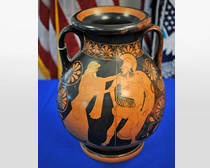
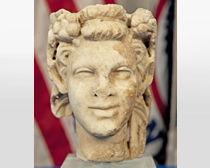
But yesterday's press announcement proclaiming the repatriation of looted and stolen antiquities to Italy simply describes a "ceremony" to return "[t]wo 2,000-year-old ceramic vessels, one Roman marble sculpture, one Renaissance painting and three music sheets from choir books dating back to the 13th century ...."  Authorities did not announce any arrests or indictments despite descriptions of criminal activity by the use of terms such as "looted," "illegally imported," "smuggled," " illicit trafficking," "organized crime," and "stolen."

In other criminal investigations, HSI agents investigate cases, work with prosecutors to develop and sift through evidence, present the results to grand jurors, and hold lawbreakers accountable.  In illegal antiquities trafficking cases, however, Homeland Security Secretary Janet Napolitano said it best during Thursday's ceremony, "We will continue to work to ensure cultural artifacts and treasures that were stolen and entered this country illegally are recovered and returned to their rightful home nations."

This "seize and send" strategy requires rethinking to coincide with the "investigate and indict" mission that other HSI investigations pursue to dismantle and deter criminal activity.

ICE Director John Morton said yesterday that "ICE is serious about reining in art and antiquity thieves, smugglers, and traffickers."  Yet antiquities thieves, smugglers, and traffickers must be brought to trial.  And while ICE poignantly warned in Thursday's press release that anyone "involved in the illicit trafficking of cultural property, art and antiquities can face prison terms of up to 20 years, fines and possible restitution to purchasers of the items," criminals must first be indicted before they can face such consequences in a U.S. district court.  Only then can the "antiquity thieves, smugglers, and traffickers" who are targeted by ICE be held to account for violating federal criminal laws.

CONTACT: www.culturalheritagelawyer.com

Ka Nefer Nefer Case Resumes After Lengthy Hiatus

St. Louis Art Museum
Lawyers for the St. Louis Art Museum (SLAM) filed a sur-reply last week in the case of U.S. v. Mask of Ka Nefer Nefer after activity in the case--at least with regard to legal filings--abruptly ended in August 2011.  SLAM submitted its pleading to the eastern district federal court in Missouri.  The court submission comments on the running dispute about whether the museum has legal standing to remain in the case.

The government filed a claim in March 2011 to forfeit the mask of Ka Nefer Nefer located at SLAM.  The 19th Dynasty Egyptian mummy mask of a noblewoman is alleged by the government to have been stolen from Egypt.

The government's forfeiture action was a response to SLAM's legal effort in February 2011 to quiet the title of the mask so that the museum potentially could own the artifact without worry.  In July 2011, federal lawyers filed a motion to knock SLAM off the forfeiture case, arguing that the museum could make no colorable legal claim to ownership because the mask is a stolen object.  The motion to strike SLAM from the case set off a volley of legal pleadings related to whether the Ka Nefer Nefer mask is contraband.  The federal government argued that possession of the mask was akin to possessing cocaine, which is illegal.

After a long absence of legal submissions, SLAM's most recent sur-reply picks up the argument once again.  The museum charges that it "has consistently taken the position that the Government’s claim is barred from the outset by the statute of limitations and that its forfeiture claim must fail because the Government is unable to prove the Mask was stolen. In raising the arguments it does, the Government is attempting to delay or avoid the consideration of those questions by confusing the standard for constitutional standing and making the bizarre suggestion that the Court pretend that the Museum claims an interest 'not of a centuries old Egyptian mask, but rather a kilogram of cocaine.'  In doing so, the Government so muddles and confuses the term 'contraband,' and the significance that the term carries, that some clarification is necessary." (citations omitted).

SLAM adds that the mummy mask is not contraband per se (such as illegal drugs) "as [artifacts] may be lawfully owned and become contraband only based on a connection with a criminal act."  Relying on U.S. v. Jeffers, 342 U.S. 48, 52-54 (1951), the museum asserts that "[t]he Supreme Court has recognized that, in the absence of a law foreclosing property rights, artifacts can be privately owned."

SLAM criticizes the government, saying that "[t]he Government’s evolving positions with respect to the ownership issue seem to be at war with themselves."  The museum argues that Egypt's patrimony law, which claims ownership of cultural objects found on its soil, is argued by the government to be a law granting private ownership in one pleading and alternatively, in another pleading,  a law that restricts private ownership.

SLAM concludes by reasserting that it has made a colorable claim to ownership to the mummy mask.

The government filed papers on March 28, 2012 for leave to reply to the sur-reply.

CONTACT: http://www.culturalheritagelawyer.com/

Court Forfeits Cristo Portacroce After Italy Does Not File A Claim

The forfeited Cristo Portacroce.
Courtesy ICE
The United States District Court for the Northern District of Florida has ordered the forfeiture of the painting, the Cristo Portacroce Trascinato Da Un Manigoldo.  The court issued the default judgment once the previous possessors, Italy and its Brera Art Gallery, failed to make a claim for the return of the artwork.

The court's ruling was brief:  "Upon Application of the Plaintiff(s) in the above styled cause and having examined the records and there appearing to be no responsive pleadings filed by the defendant(s), default is hereby entered against the Italian Republic, Ministry of Culture, and the Pinacoteca di Brera, on January 3, 2012."

The painting will likely be handed over to the heirs of Federico Gentili di Giuseppe, who filed a claim on December 14, 2011 arguing that they were the lawful owners.  Prosecutors submitted information to the court that the painting was taken from the family by the Nazis during World War II.  Click here for details.

Federal officials seized the Cristo Portacroce in November 2011, which the Mary Brogan Museum of Art and Science in Florida had on loan.  See here for background.

Court papers filed by government lawyers show that the Italian's were aware that the painting's ownership was in dispute.  But the records do not explain why the Italy-Brogan loan agreement did not contemplate legal protection from seizure under the federal law known as Immunity from Seizure Under Judicial Process of Cultural Objects Imported for Temporary Exhibition or Display.

ICE Seizes Stolen Art From Florida's Brogan Museum - Said To Be Taken During WWII

ICE seizes Romano painting said to be stolen by the Nazis.  Photo courtesy of ICE
Immigration and Customs Enforcement (ICE) officials in Tallahassee, Florida yesterday served a seizure warrant on "Christ Carrying the Cross Dragged by a Rascal."  The painting had been held at the Mary Brogan Museum of Art and Science at the request of the US Attorney's office, northern district of Florida, while prosecutors determined whether the painting by Girolamo Romano’s was unlawfully taken from a Jewish family during World War II.  Now the artwork is now in federal custody.

Who will have final title and possession of the artwork ultimately will be determined by a federal district court judge.

[UPDATE: November 9, 2011 - Read more details here.]

Find the complete press release describing the seizure and issued by ICE here.  Also, listen to Chucha Barber, the Brogan Museum’s chief executive officer, who provides a short audio sketch of the ownership claims to the painting on PRI's The World.

Thanks go to Gary Nurkin for alerting me to this news.

Commentary on SLAM Mummy Mask Case - Proceeds Contraband and Statute of Limitations

The current civil litigation surrounding whether the Ka-Nefer-Nefer mummy mask is contraband is worth following given the current legal arguments in play.

The mask, located at the St. Louis Art Museum (SLAM), is claimed by the federal government to be contraband, which is always unlawful to possess. SLAM, meanwhile, argues that the mask, if it is contraband, must be considered derivative contraband, compelling the government to prove that the mask was utilized in the commission of a crime.

It is open to discussion whether the mummy mask fits into the same category as contraband like illegal narcotics. It is also remarkable to think of the mummy mask as derivative contraband like a car used in illegal gun running. It may be that both legal theories are inexact.

The mummy mask might be categorized as proceeds or fruits instead.

Broadly speaking, criminal search and seizure law categorizes property as fruits, instrumentalities, or contraband. Fruits of a crime are the proceeds of a criminal transaction. These items are ones connected with a criminal act and may be seized. Instrumentalities are objects used to facilitate a crime, and these too may be seized. Contraband items are ones that are plainly unlawful to possess like counterfeit money, and these too may be seized.

In the realm of civil forfeiture of property, particularly dealing with items alleged to be connected to a crime, these criminal law concepts of fruits, instrumentalities, and contraband may be translated into three legal theories: proceeds forfeiture, instrumentalities forfeiture, and contraband forfeiture. If contraband forfeiture is the argument of the government, and instrumentalities forfeiture is the argument of the museum, will proceeds forfeiture be considered by the court? We shall see.

Meanwhile, SLAM’s assertion that the statute of limitations has expired in this case, preventing the government from pursuing its court action, is an argument worth watching closely. Statute of limitations is always an issue of importance when applied to cases of fine art and cultural heritage. In the Ka-Nefer-Nefer mummy mask case, it should be noted that the statute of limitations would not likely apply if the mummy mask is categorized as contraband per se. That is because it would be unlawful to possess the mask under any circumstance at any time. And that is perhaps one reason why the government hopes to characterize the mask as contraband, because it could potentially steer the case away from litigation over the statute of limitations altogether.

We look forward to further developments.

DISCLAIMER: The information provided here is general information only, not legal advice, and not guaranteed to be current, correct, or complete. No attorney-client relationship is formed, and no express or implied warranty is given. Links or references to outside sources are not endorsements. This site may be considered attorney advertising by some jurisdictions. The attorney is licensed in NH. The attorney is not certified by the TX Board of Legal Specialization, nor certified by NY regulators as a so-called "specialist" or "expert." Do not send confidential communications through this site. Contact information may be found at www.culturalheritagelawyer.com.

SLAM Disputes Government's "Contraband" Claim in Ka-Nefer-Nefer Mummy Mask Case

In the latest round of legal papers filed in the case of United States v. Mask of Ka-Nefer-Nefer, the St. Louis Art Museum (SLAM) says that its possession of the ancient Egyptian mummy mask cannot be likened to possession of cocaine as the US government's lawyers claim. (See July 31, 2011 blog post for background.)

SLAM's attorneys describe two kinds of contraband. They explain that there is contraband per se, which include items illegal to possess under any circumstance (author's note: think of counterfeit money) and which can be automatically confiscated by the government without a hearing. They also say that there is derivative contraband, which include lawful items that are forfeitable because they are connected with a crime (author's note: think of a car used in drug trafficking). SLAM argues that if the mask is in fact contraband, then it must be characterized as derivative contraband that is not automatically forfeitable. Because the mask is not automatically forfeitable contraband per se, SLAM argues that the government must present evidence that the object is forfeitable as an item that derives from a criminal act.

SLAM writes in its August 3, 2011 pleading (some citations omitted):
"The Government’s evolving positions with respect to the ownership issue seem to be at war with themselves. First, it admitted in its own pleadings that there are several bases under [Egypt’s patrimony] Law No. 215 which would provide for private ownership of artifacts such as the Mask. Now it argues that Egyptian Law No. 215 forecloses property rights in artifacts such as the Mask and renders them contraband per se, akin to cocaine or an illegal whiskey still. In fact, Egyptian Law No. 117, which was enacted in 1983, after Law No. 215, specifically acknowledges that artifacts such as the Mask could be privately owned. United States v. Schultz, 333 F.3d 393, 401-02 (2d Cir. 2003). In that seminal case, the Second Circuit went on to recognize that Law No. 117 was the first Egyptian law declaring illegal any private ownership of all antiquities found in Egypt after 1983. The Mask, therefore, clearly cannot be considered contraband per se in the way that such items as narcotics are intrinsically unlawful to possess."

By making the claim that the mummy mask arguably can be characterized contraband derived from a crime, SLAM tries to reinforce its assertion that the burden of proving the forfeiture is on the government.

Meanwhile, it should be noted that the issue of whether the statute of limitations forecloses the government's seizure action is an argument that SLAM continues to raise. SLAM's lawyers write:
"The Museum has consistently taken the position that the Government’s claim is barred from the outset by the statute of limitations and that its forfeiture claim must fail because the Government is unable to prove the Mask was stolen. In raising the arguments it does, the Government is attempting to delay or avoid the consideration of those questions by confusing the standard for constitutional standing and making the bizarre suggestion that the Court pretend that the Museum claims an interest 'not of a centuries old Egyptian mask, but rather a kilogram of cocaine.'"

The United States Attorney's Office counters SLAM's latest assertions in a pleading filed August 4, saying that SLAM failed to make arguments about the contraband issue when it was supposed to. The government’s lawyers contend that SLAM never before raised the distinction of contraband per se and derivative contraband, writing that the museum only now “disputes whether private ownership of the Mask is authorized under Egyptian law.”

Seizure of Mexican Figurine Prompts Question of CBP's Legal Authority

United States Customs and Border Protection (CBP) announced in a new(s) release on July 28, 2011 that it seized a Pre-Columbian artifact en route from Indiana to British Columbia. A buyer in Canada reportedly purchased the small orange Nayarit figure of a woman through an auction, and CBP agents intercepted the package in April during routine checks at Chicago's O'Hare Airport. CBP said that the shipment was "manifested as containing an artifact."

CBP and Immigration and Customs Enforcement-Homeland Security Investigations (HSI) had the Chicago Field Museum examine the object, concluding it "to be an authentic Pre-Columbian artifact of West Mexico dating to the early first millennium AD." The Consulate General of Mexico, meanwhile, claimed that the object was unlawfully exported from that country.

CBP seized the four inch tall Nayarit figurine under Title 19, Chapter 14 of the customs laws. The statute is commonly referred to as the Convention on Cultural Property Implementation Act (CPIA), meant to implement the well-known 1970 UNESCO Convention that covers cultural property. Federal agents in Chicago took the ancient Mexican artifact into their possession under Section 2609 of the CPIA, which permits seizure of protected cultural artifacts covered by import regulations promulgated under section 2606 (as well as stolen objects that had been documented in the institutional collection of a state party to the convention). Import restrictions enacted under Section 2606 result when the United States enters into an agreement with another nation under the authority of the CPIA. Many readers of this blog are familiar with the CPIA process and know that several nations have bilateral agreements with the United States pursuant to CPIA. Mexico, however, is not one of those nations.

So how can CBP take away an ancient Mexican cultural object from its possessor by using the CPIA? I called CPB to find out. The agency's representatives were polite and responsive to calls, but the replies were not helpful. A CBP Associate Chief Counsel said that "we don't comment on anything like this," adding that "we limit any of our comments about the law and our interpretation on the law to our client itself, which is, of course, the agency." Such a closed response from a government agency that actively sought public attention to this seizure and freely declared the legal basis for the seizure is unsatisfactory. CBP issued a public press release announcing the taking of the Nayarit figurine and broadcasted that "[t]he artifact will be returned to the Mexican government in an upcoming CBP and ICE-HSI repatriation ceremony." And while the agency claims the matter is under investigation, CBP's desire to return potential evidence to Mexico, coupled with its early public release of information relevant to the case, does not signal a meaningful commitment to maintain the integrity of the investigation.

We are left to speculate about what CBP may have been thinking when it seized the object. Federal officials could not have seized the Mexican artifact under a legal theory involving the National Stolen Property Act because the NSPA requires an item to have a value of $5000 or more before it is considered stolen under that law. The Mexican artifact was purchased at auction for $550, far less than $5000. So CBP had to look for other legal authority to take the artifact into custody.

Perhaps they erringly looked to a treaty for legal authority? The United States and Mexico entered into a Treaty of Cooperation on March 24, 1971, which provides for the recovery and return of stolen archaeological, historical, and cultural properties. The treaty, which is in force today, permits the United States "to employ the legal means at its disposal to recover and return from its territory stolen archaeological, historical and cultural properties that are removed after the date of entry into force of the Treaty from the territory of the requesting Party." But this agreement was not enacted into law under the terms of the CPIA, meaning there are no import restrictions on Mexican cultural property that derive from Section 2606 of the CPIA to justify a Section 2609 seizure of the Nayarit figurine by CBP.

So what exactly was CPB's legal authority to seize the Nayarit figurine? We have no explanation about why a Section 2609 seizure was the proper legal basis to take away the ancient Mexican artifact.

Federal officials must take great care when using unexplained interpretations of the law to promote seizures of property. While CBP may be commended for taking action to detect trafficked cultural heritage, federal authorities should exercise their authority in a reasonable, intelligent, and open fashion. No citizen should be left guessing about how exactly he or she can comply with the law so as to avoid the loss of property. Clear and reasonable applications of the customs laws, and plain explanations to back them, can build public support for America's effort to protect and secure at-risk cultural property. By contrast, offering questionable or undisclosed legal positions in cases where property may be seized—particularly in cases involving potentially innocent possessors—does little to garner confidence in public authorities.

Photo: Chicago CBP

US Claims SLAM Lacks Legal Standing—Asserts That Mummy Mask is Illegal Contraband —Discovery Reveals More Information

In the latest round of papers filed in court last week, lawyers for the US Attorney’s Office in St. Louis sought to strike the St. Louis Art Museum’s legal claim in the federal lawsuit involving the mummy mask of Ka-Nefer-Nefer. Federal authorities sought forfeiture of the mask in March after the museum filed for a declaratory judgment in February seeking quiet title to the artifact. Both cases were filed in federal district court in St. Louis.

Federal attorneys, in their July 27 pleading, contend that SLAM’s “claim of ownership is legally impossible, and as such the Mask is effectively contraband in the hands of the Museum.” The government argues that Egypt’s patrimony law, which gives ownership rights of cultural property to the Egyptians, makes it impossible for the SLAM to own the mummy mask. Therefore, SLAM has no legal standing to assert that it can own the mask.

The government’s brief analogizes SLAM’s claim to the mask as similar to asserting ownership over cocaine—one cannot legally claim ownership. Since the mask cannot be owned by the museum, the museum lacks standing to claim ownership, the government argues.

SLAM says that it has standing to be a legal party in the case because it bought the mask and it possesses it.

The government first disputed SLAM’s legal standing in a July 7 motion. Government attorneys filed the pleading following the receipt of interrogatory answers by SLAM. While the museum wrote that it objected to having to answer questions about how it acquired title to the mask or having to identify documents that would support its claim to lawful ownership, SLAM, nevertheless, answered the interrogatories without waving these objections.

The museum supplied the following information:

• It purchased the mummy mask for $499,000 from Phoenix Ancient Art of Geneva, Switzerland around April 3, 1998.

• Phoenix Ancient Art warranted in a purchase and sale agreement that it had title to the mask and could properly transfer title.

• Phoenix provided provenance information to SLAM before the purchase. “According to Phoenix, in or about 1995, it had purchased the Mask from Ms. Zuzi Jelinek, who in or about the early 1960’s, had purchased the Mask from the Kaloterna (or Kaliterna) private collection,” the interrogatory answer relates.

• The museum conducted a provenance investigation to determine if the mask was stolen by contacting INTERPOL, the Missouri Highway Patrol, the Art Loss Register, and the former director of the Museum of Egyptian Antiquities in Cairo, Dr. Mohammed Saleh.

• The museum conducted an investigation through Swiss legal counsel to determine if there were any liens or encumbrances on the mask. No encumbrances were found.

• Swiss legal counsel confirmed Jelinek’s address.

• The museum contacted Dr. Saleh, who advised SLAM to contact another US museum and who did not say that the mask was stolen or “advise the museum against purchasing the Mask.”

SLAM also provided a spreadsheet of 19 documents, which it claims supports the museum’s legal interest in the mummy mask. The documents can be categorized as a purchase agreement, a bill of sale, letters, and emails.

Missing from the documents list is a purchase or sales agreement between Jenilek and Pheonix Ancient Art. SLAM claimed in past court filings that such a transaction would have occurred in 1995. SLAM, nevertheless, includes on the list of documents a 1997 fax from Phoenix that purportedly attaches a letter of provenance from Jenilek.

Also missing from the documents list are shipping papers or import papers describing the mask’s entry into the United States. Import papers generally describe a package’s date of entry, location of entry, country of origin, value, and contents. The court papers suggest that the mummy mask traveled from Switzerland to the United States in 1998, but this information remains unclear. The mask must have been imported into the United States at some time and at a specific point of entry. But the question of whether papers exist documenting the importation of the Egyptian mummy mask, valued at several thousands of dollars, remains unanswered thus far.

Changing Course: Enhancing Homeland Security's Policy of Seizure and Repatriation with Investigation and Prosecution

Illegal antiquities trafficking is a global business, linked to major transnational crimes such as money laundering. Additionally, cultural property crimes target humanity’s heritage and spirit. In order to successfully tackle crimes against cultural heritage, federal officials must pursue a strategy of investigation and prosecution.

The current policy of seizure and return does not go far enough. To seize a stolen or smuggled artifact at the American border and return it to its country of origin only serves to repatriate the object. Its confiscation and return does little to deter antiquities trafficking since there is minimal consequence to the perpetrators or accomplices. Building legal cases that lead to arrests and prosecutions would provide both specific deterrence and general deterrence.

The seize and return policy maintained by Department of Homeland Security (DHS) recently came into public view when Customs and Border Protection (CPB) and DHS investigators seized two Chinese artifacts illegally crossing America's border at Newark Liberty International Airport around March 3. Eight days later DHS announced the return of fourteen cultural objects to China, many obtained as a result of an enforcement initiative titled Operation Great Wall. The objects repatriated apparently included one of the artifacts seized at Newark Airport, specifically a Tang Dynasty horse. At least four other Chinese cultural objects that were seized in the New York metropolitan area over the past year were returned to China as well.

Typically when law enforcement officials seize the fruits of a crime or contraband they secure the evidence in anticipation of a prosecution. The return of the Tang Dynasty horse sculpture only a few days after federal officials seized it illustrates how smuggled cultural objects are not treated as criminal case evidence. That is to be expected when the primary mission of DHS is to seize and return, not to investigate and prosecute.

US Customs Director Robert Perez articulated this seize and return policy, declaring that federal authorities are "dedicated to intercepting [cultural] items and ensuring their safe return to their rightful owners." DHS’s news release about the repatriation of Chinese artifacts supports this view, highlighting that “2,300 artifacts have been returned to 18 countries since 2007.” While DHS touts the number of seizures and returns of cultural property, its press statement does not boast of any prosecutions or convictions against looters, smugglers, fences, or receivers of illegally stolen or trafficked cultural heritage.

Combating crimes against cultural heritage requires authorities to investigate and prosecute trafficking rings. Effective law enforcement is characterized by thoughtful investigation, careful handling of physical evidence, and assembly of evidence for review and use by prosecutors. While seizing and repatriating illegally smuggled artifacts serves some purpose to curb antiquities trafficking, federal officials cannot be credited with performing a thorough job if this remains the sole accomplishment.

Immigrations and Customs Enforcement investigators and Customs and Border Protection agents are skilled law enforcement officers who are capable of combating antiquities trafficking effectively. We need to call on DHS policymakers to directly engage illegal antiquities networks by adopting a policy of investigation and prosecution that enhances the existing policy of seizure and repatriation.

Sources:
www.ice.gov/news/releases/1103/110311washingtondc.htm

http://articles.cnn.com/2011-03-03/justice/new.jersey.artifacts.seized_1_newark-airport-antiquities-chinese-government?_s=PM:CRIME

Blogroll

azplanningforwildlife.com m2tvchannel.com bapedaldaprovjambi.com kreis-dl.net news-1212.com landratsamt-doebeln.net landkreis-doebeln.net canadiangoldreserves.net chicagohearse.com tattooremovalessex.com braziltrade-uae.com 333asia.com calliemacdesigns.com gemdoc.net simplefoodjuiceplus.com postabortionstresssyndrome.com descendingpath.com casadopinhole.net myspeechandlanguage.net sezambook.com rerecognition.info bebetsy.info carsoncitybraces.info summitcardiology.info sanfojiangsi.info trailheadgeararchery.info immigrationconnect.info nhhomeless.info tundradialogues.info ibexretail.com kreis-dl.com agiles-eam.com bestbcgolfcourse.com niittyneito.com yenikapimevlevihanesi.com hnr100.com eplogin.com richard-wagner-festival.com landratsamt-doebeln.com lra-doebeln.com terrecatalane.com thesmarterhybrids.com Political Science,Politics And Religion,Lamp For Home,Internet Media Services,Book Holidays Online,Electric Car Engine,House And Garden Magazine,Fashion Art Music,Allobits Business Finance Solutions,Amelia Island Living,Sectb Business management,Biblepl College And University,Synergysigns Home Furniture,Marketing and Promotion,Meristem Nature,Success Business,Food and Nutrition,New Health Foundation,Real Estate Designer,Chase Auto Loans,Economic and Business Review,Business Insurance Quotes,Gambling Commission,Game and Media Technology,TakingBusinessOpportunities,MedicalCenter,FashionModelling,FashionCelebrity,BusinessMarketing,ComputersandTechnology,SubjectAboutTechnology,Children'sEducation,EconomicsBusinessandFinance,Entertainment,BusinessAccounting,HealthTechnology,AirHealth,BodyHealth,HousingDesigners,ArtsandEntertainment,GamingTournament,ForexEducation,HomeDesignIdea,BeautyClinic Professional Translation Streaming Wizard Alcoholism and Drug Medical Laboratory Commerce Business Educational Kids Play Space Education Home Repair Volunteer Fashion Talent Health and Safety Executive Play Web Games Travel and Surfing Property and Estate Agents Technology Group Solutions Student Service Center Construction Industry Media Center Computer Teny Fashion Home Remodeling Services Inspector Network Car Rentals Leader Dogs Rise Health Systems Business Strategy Consultant
Personal Life Coaching
Company Business Coaching
Entertainment News
Physics and Astronomy
Science and Technology
Cheap Vacation Packages
World Business Academy
Planets Project
Travel and Leisure
Prevent Drug Abuse
Education Certified
Play Kids Games
Legal Defense Fund
Real Estate Strategies
Isolation Globale
Insurance Coverage Law
Rock Hotel and Resorts
Medical Insurance
Healthy Mind and Body
Marjahaan Autokatsastus
Free Sports Authority
Auto Insurance Coverage
Global Technics
Advitium Manufacturing
Professional Core Education
Special Finance Services
Bergen County Contractors
Great Children's Art
Health Supply Company
Social Media Power
Texas House Restaurant
Carbon Consultant
Carbon Expert
Low Carbon
Reset Carbon
Healthcare Commissioning
Virtual Job Tryouts
Ethos Academy (Education)
Intrinsic Schools
Attorney General
Technology Software
Business Plans
Digital Media
High School Resources
Adult Resources
Gamblers Anonymous
Ecuador Real Estate
Software Development
Festival Fashion
Drugs And Alcohol
Food Network Recipes
Journal Human Resources
Games and Technology
Technology Development
Web Resources Express
Payday Loans Bad Credit
Art and Craft
Business and Finance News
Ecological Sciences
Education Resources
Web Design
Music Education
World Resources Institute
Business Health Guide